

I Googled 'best coliving companies in the world'. Then I asked the AIs (Claude, Chatgpt, & Gemini)
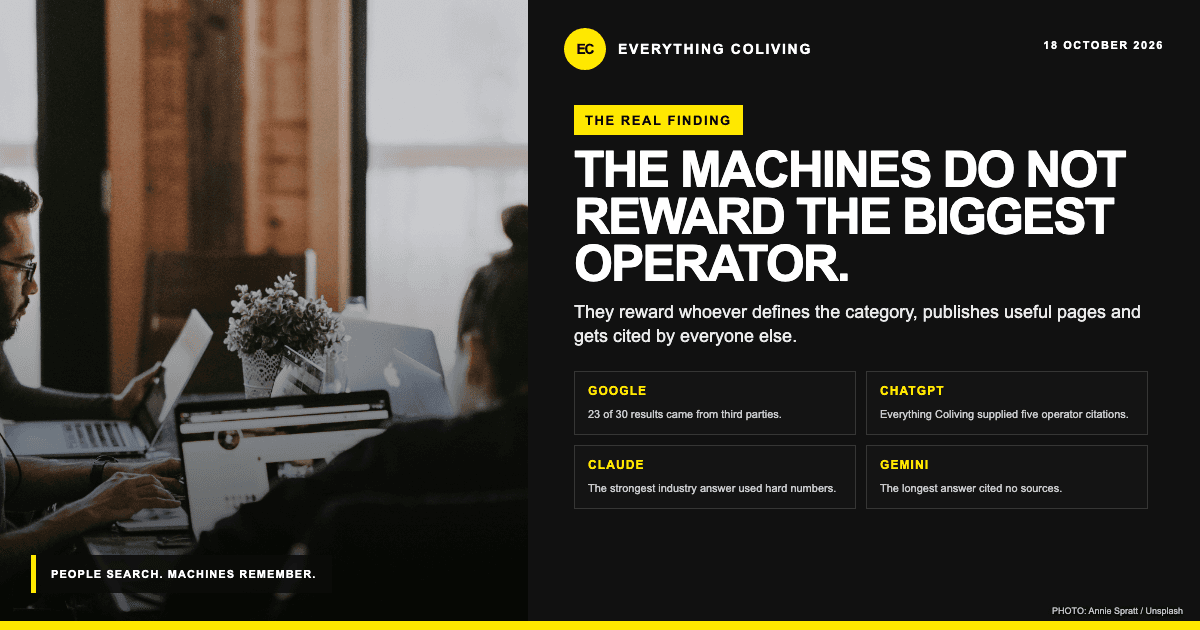
Google's number one answer to "best coliving companies in the world" is a B2B sales-data list that ranks a US student housing giant as the top coliving operator. That one result tells you most of what you need to know about how this industry shows up online.
I get asked this question all the time. Investors ask it. Founders ask it. Journalists ask it before a story. And more and more, people don't ask me. They ask Google, or they ask ChatGPT, Claude or Gemini.
So on a Sunday afternoon I did what any curious person would do. I typed the exact phrase into Google, went through all 30 results on the first three pages, and then put the same question to the AI assistants. Same words, no tricks, no follow-ups.
What came back is a mess. An interesting mess, though. It shows who is shaping the story of coliving, and more usefully, what each platform rewards. If you run a coliving business and want to show up when someone asks this question, that's the part to read.
How I ran it
One query, typed exactly: best coliving companies in the world. Run on 18 October 2026.
Platform | Setup | What I captured |
|---|---|---|
Chrome, signed in | 30 organic results across pages 1 to 3 | |
ChatGPT | Logged out, temporary chat | Full answer, cited sources, any ads |
Claude | Opus 5.5, incognito chat, web search on | Full answer and cited sources |
Gemini | Signed in, Gemini Auto | Full answer and any cited sources |
A few honest caveats before we go further.
Google was personalised. Results differ by person and place. This is what a real, signed-in search returned that day.
Everything Coliving is mine. It shows up in this data. I'll call it out where it does, including where it falls short.
One run is a snapshot. AI answers change between sessions. Treat this as a picture of one Sunday, not a ranking.
Google: 30 results, 7 operators
Google doesn't really answer the question. It answers a different one. Only 7 of the 30 results come from an actual coliving operator. The other 23 are people talking about operators: directories, travel bloggers, startup databases, Reddit threads and a Pinterest pin.
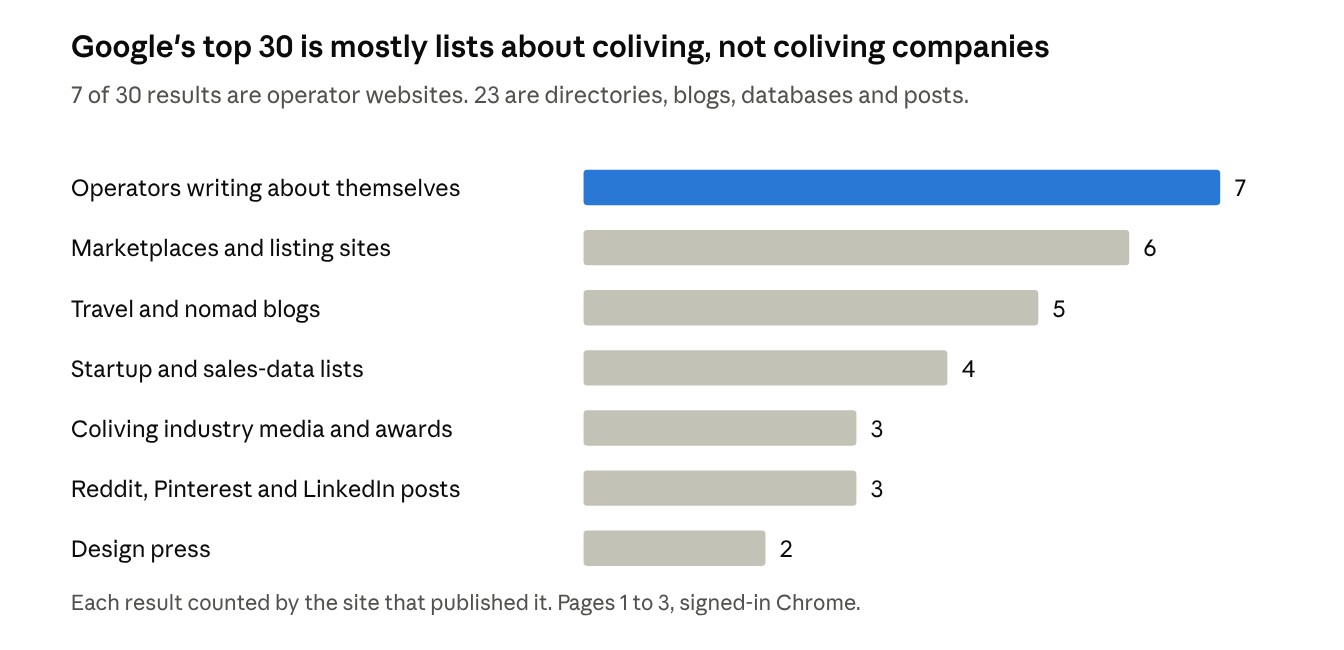
Source: Google search, 18 Oct 2026. 30 organic results, pages 1 to 3. Full list in the appendix.
What stood out when I went through them one by one:
The number one result is a sales-lead list. RevenueBase, a B2B data company, ranks "co-living operators" by how many contacts it holds at each firm. Its top three are American Campus Communities, Zolo and Blueground. That's student housing, an Indian PG brand and furnished apartments. None of them is what most of us would call coliving.
Google thinks you want a place to stay. 18 of 30 results are about spaces for digital nomads, not companies. I asked for companies. Google heard "where should I go next?"
Operators rank themselves. Casa Basilico's "best coliving" article puts Casa Basilico first. Outsite and WiFi Tribe rank with their own guides. Fair play to them. That's how you win this query.
Some of it is old. A Dezeen piece from 2016 and a three-year-old Reddit thread still sit on page one.
India shows up a lot. 5 results are Indian brands (Colive, Zolo, Cofynd, Instadwell twice). All four "People also ask" questions were about India.
My own page ranks number two. Everything Coliving's top coliving spaces page sits second and sends readers into city guides where operators are named. That's direct exposure for those operators on a query they'd struggle to rank for alone. That's what an industry page ranking should do.
ChatGPT: a nomad's shortlist, and an ad
ChatGPT gave me 10 names and a sensible caveat: "best" depends on what you want. Then it answered like a travel blogger.
# | Company | ChatGPT's label |
|---|---|---|
1 | Best overall for remote workers | |
2 | Best for global choice | |
3 | Best for close-knit community | |
4 | Best for curated networking | |
5 | Social, hostel-like stays | |
6 | Large-scale residential, Europe | |
7 | Design-led shared housing | |
8 | Affordable room-by-room housing | |
9 | Singapore | |
10 | Hybrid hotel, cowork and stay |
Three things jump out.
The top five are travel products. Four of them are built for people who move every few weeks. The real coliving businesses, the ones with thousands of beds and lenders behind them, come second as "other operators worth studying". No Outpost, no Stanza Living, no Common.
Everything Coliving was its main source for the operator half. Habyt, Cohabs, PadSplit, Coliwoo and The Social Hub each carried an Everything Coliving citation. The travel half leaned on nomad sites like coliving.love, Digital Nomad World and NomadsToolsLab. So the answer is only as good as whoever wrote clean, structured pages about the topic.
There was a sponsored ad. Under the answer sat a "Sponsored" card from Amber, the student accommodation marketplace, pushing London rooms. The tracking tag read Chatgpt_Leads_UK_India. So the first paid placement I've seen on a coliving question in ChatGPT is a student housing platform buying leads. Coliving operators are not in that auction yet. Someone else is.
Claude: the industry view, by region
Claude ran three web searches and came back with something closer to an analyst's note. It opened by saying there's no official ranking, then grouped operators by region and by what's actually happened to them.
Region | Who Claude named |
|---|---|
North America | Outpost (now merged with June Homes, about 4,000 units), PadSplit, Starcity |
Europe | Habyt, Cohabs, Flat, The Collective, Node Living |
Asia-Pacific | Stanza Living, Zolo, Colive, Settl, Lyf by Ascott, Cove, Hmlet |
Remote-worker coliving | Outsite, Sun and Co. |
Marketplaces | Coliving.com, HousingAnywhere |
That's 19 operators and platforms, almost three times the operator sites Google surfaced. It also told the story most lists skip: Habyt shrinking after its merger with Common, Selina and Roam gone, Cove buying Casa Mia in Singapore, Hmlet now under Mitsubishi Estate.
Its closing line was the bit I liked most. The global mega-operator model has largely failed. The winners are disciplined operators with real local density. I've been saying that for years, so I'm biased.
Its sources were news and industry sites: Business Wire, Urban Living News, Artof.co, CB Insights, Remote Work Europe. It also quoted a stat from the Everything Coliving newsletter on Substack.
One miss: it still listed PadSplit and Zolo as coliving. More on that below.
Free Newsletter
Join 37,000+ coliving professionals
Weekly insights on operations, marketing, and growth, delivered to your inbox.
Gemini: confident, sourceless, and out of date
Gemini gave the longest answer, 14 names in four buckets. It also gave zero sources. No links, no citations. It answered from memory, and you can tell.
Bucket | Who Gemini named |
|---|---|
Global brands and nomad networks | Outsite, Selina, Noma Collective |
Destination and community spaces | Sun and Co., Sun Desk, Nine Coliving, Mokrin House |
Urban long-term operators | Habyt, The Collective / Folk, Neighbourgood, UKO |
Discovery platforms | Coliving.com, Anyplace / BookMyColiving |
The problem is the second name on the list. Gemini describes Selina as having 100+ locations across four continents. Selina's collapse is the story of the sector over the last two years. Claude's sources called it gone. Remote Work Europe's 2026 guide, sitting at number 30 on Google, is literally titled around who's still operating after Selina.
It also says Habyt acquired Hmlet. Hmlet now sits under Mitsubishi Estate after Habyt sold its Asia business. And it merges The Collective and Folk into one company.
Gemini did go wider on geography than anyone else: South Africa, Australia, Serbia, Morocco. Nobody else named UKO or Neighbourgood.
Disclosure: Gemini listed BookMyColiving as a discovery platform. That's mine. I didn't ask it to. It's counted in the overlap below, flagged as mine.
Where they agree: two names, and the next one isn't coliving
Across all four platforms, 38 different names came up. Only two appeared everywhere: Outsite and Coliving.com. PadSplit made three of four, missing only Gemini.
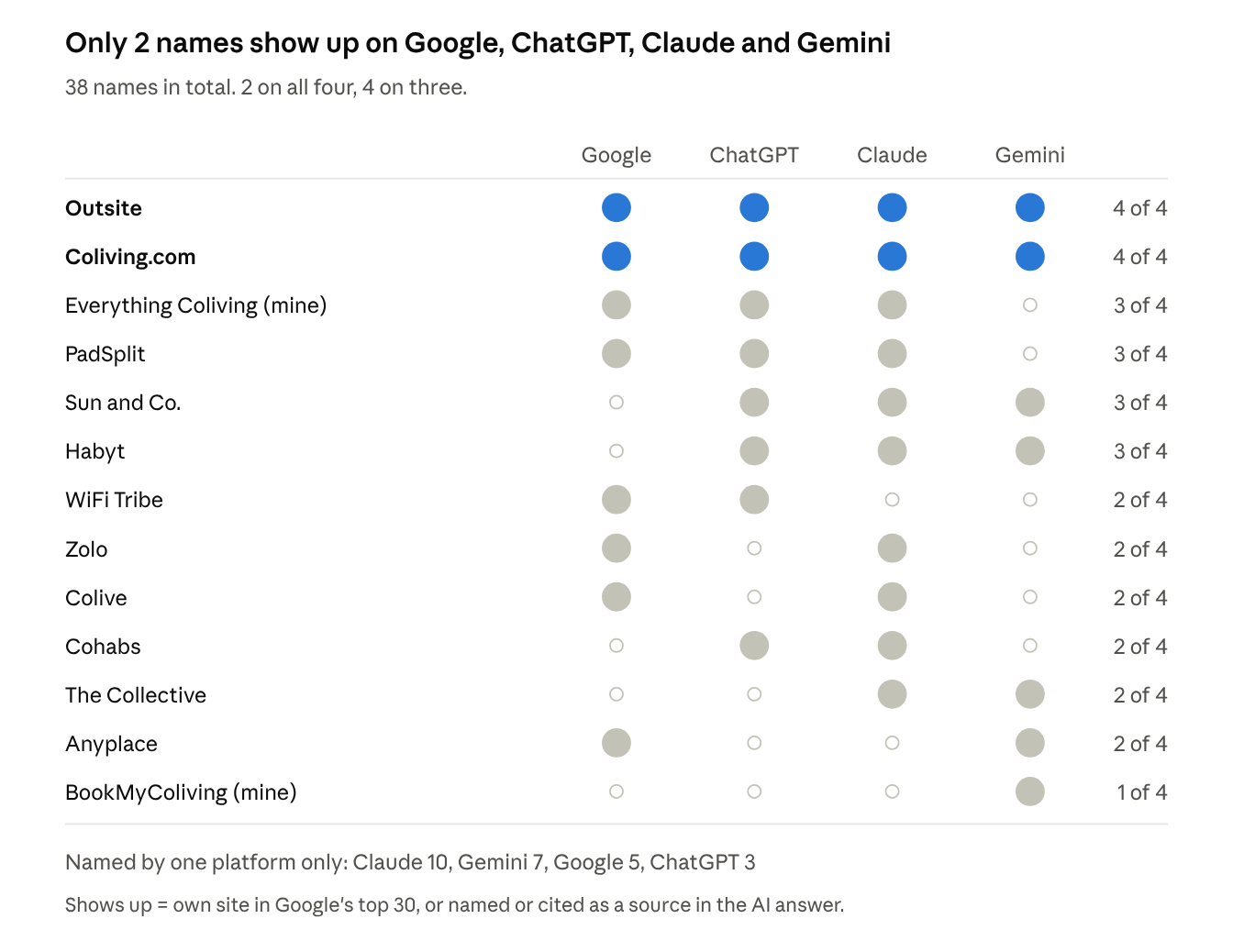
Source: Google top 30 and the ChatGPT, Claude and Gemini answers, 18 Oct 2026.
Look at that list again. Outsite is a remote-worker stay brand. Coliving.com is a marketplace. PadSplit is room rentals for the workforce. I've said it many times and I'll say it again: PadSplit is house sharing, not coliving. Zolo is a PG. They're good businesses. They're just not the thing the question is about.
So the only point of agreement across Google and the three biggest AI assistants is a travel stay brand and a directory. The next name down is a house-share platform. Meanwhile the operators who define coliving at scale, Outpost, Stanza Living and Cove, showed up on exactly one platform each. That's the definitional mess I keep writing about, now baked into the machines.
I've put my own two properties in the matrix too, flagged, because they're part of the picture. Everything Coliving shows up on three of four: ranked second on Google, cited five times by ChatGPT and once by Claude. Only Gemini, which cited nobody, left it out. BookMyColiving shows up once, named by Gemini as a discovery platform. That's the same pattern as Outsite and Coliving.com. The names that show up everywhere are the ones that publish structured, useful pages about the industry, not the ones with the most beds.
Who actually gets named: operators, marketplaces and travel clubs
I sorted all 37 names by what they actually are. This is where it gets interesting. The big urban operators, the ones housing tens of thousands of people, barely make the lists.
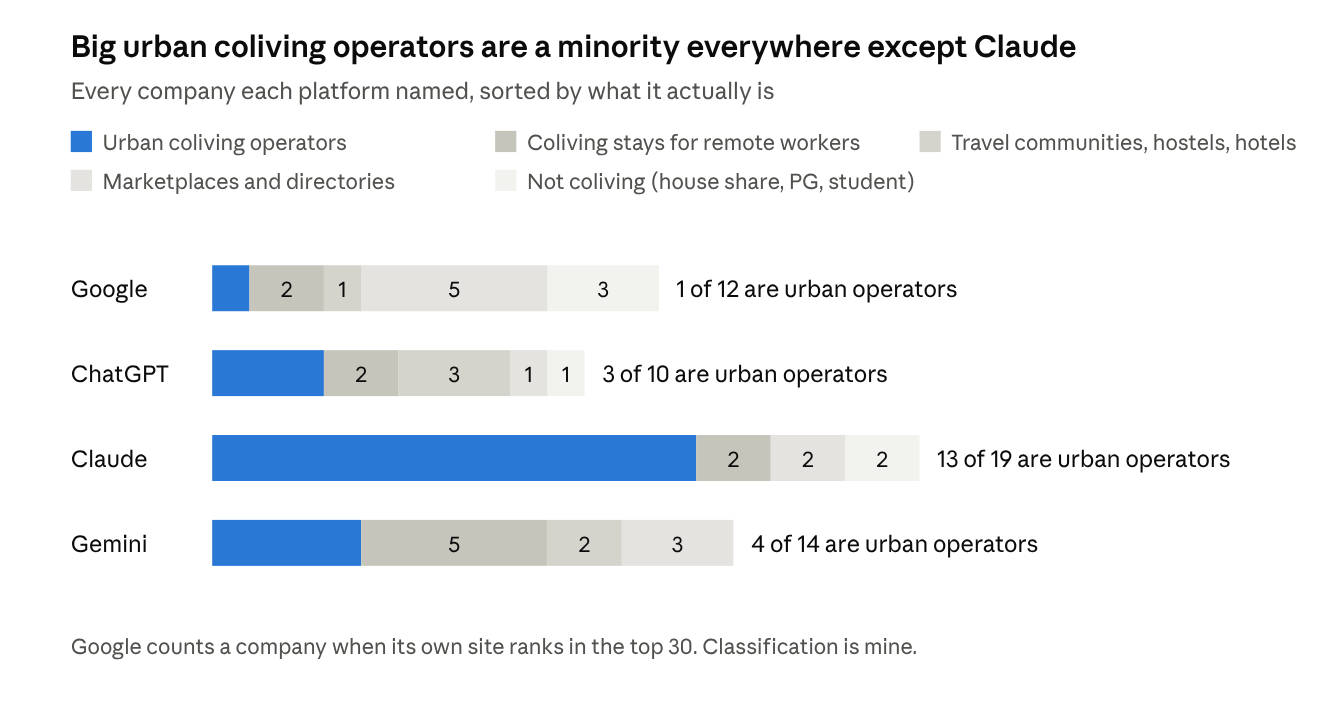
Source: all names across Google, ChatGPT, Claude and Gemini, 18 Oct 2026. Classification by Everything Coliving.
Only Claude's answer is mostly real urban coliving operators. Everywhere else, the space goes to marketplaces, small remote-worker houses and travel clubs.
Take WiFi Tribe. It's a travel community. Members move between destinations together. It's not coliving at all, and it still ranks on Google and gets named by ChatGPT as one of the best coliving companies in the world. Selina, Socialtel and The Social Hub are hostels and hotels with a coworking floor.
Now look at size. Sun and Co. is a single 14-bed house in Spain, by Claude's own description. It shows up on three of four platforms. Stanza Living, which Claude says runs about 70,000 beds, and Outpost, the biggest US operator after its June Homes merger, show up on one. The machines reward whoever writes about themselves, not whoever houses the most people.
Type | Who's in it |
|---|---|
Urban coliving operators (16) | Habyt, Cohabs, The Collective, Outpost, Starcity, Flat, Node Living, Stanza Living, Colive, Settl, Lyf, Cove, Hmlet, Coliwoo, Neighbourgood, UKO |
Coliving stays for remote workers (6) | Outsite, Sun and Co., Casa Basilico, Sun Desk, Nine Coliving, Mokrin House |
Travel communities, hostels, hotels (5) | WiFi Tribe, Noma Collective, Selina, Socialtel, The Social Hub |
Marketplaces and directories (7) | Coliving.com, Anyplace, HousingAnywhere, BookMyColiving, Cofynd, Coliving Compass, Remoters |
Not coliving (3) | PadSplit (house share), Zolo (PG), Instadwell (student housing) |
What each platform rewards, and how to rank on it
Each of the four platforms rewards a different behaviour. Read the results backwards and you get a marketing plan.
Platform | What it rewards | Evidence from this test | What to do |
|---|---|---|---|
Pages that match the phrase and are written as lists. Domain authority beats freshness. | 23 of 30 titles say "best", "top" or a number. A 2016 Dezeen piece and a 3-year-old Reddit thread still rank. Directories like Tracxn and F6S rank on sheer scale. | Publish your own honest "best coliving in X" list. Get listed on directories and startup databases. Show up on Reddit and LinkedIn. | |
ChatGPT | Clean, structured third-party pages it can quote, and a clear "best for" angle. | Every pick came with a "best for" label. Everything Coliving was cited five times for the operator half; nomad blogs carried the travel half. One paid ad sat under the answer. | Say clearly who you're best for, on your site and on others'. Get described on industry and roundup sites. Watch ChatGPT ads before a competitor owns your query. |
Claude | Verifiable facts from news and data sources: units, cities, funding, mergers. | Its sources were Business Wire, Urban Living News, CB Insights and Artof.co. It named 13 urban operators, the most of any platform, each with a hard number or a deal. | Put your numbers out on the record. Issue press releases with unit counts, cities and deals. Keep your Crunchbase and CB Insights profiles current. |
Gemini | Brand memory. Names written about the most, for the longest. | Zero sources cited. It still lists Selina with 100+ locations, and old favourites like Nine Coliving and Mokrin House. | Build a long footprint: years of mentions, interviews and listings. Correct stale facts about you wherever they're widely read. |
The cross-platform playbook
Outsite and Coliving.com are the only two names on all four platforms. Neither is the biggest operator. Both publish constantly about the category and sit on everyone else's lists. That's the model. Here's how I'd copy it.
Write the list yourself. Casa Basilico, Outsite and WiFi Tribe all rank with their own "best coliving" guides. Include competitors. An honest list gets linked and quoted. A brochure doesn't.
Get on other people's lists. 23 of Google's 30 results are third-party pages. The AIs read the same pages. Directories, marketplaces, industry media and nomad blogs decide who gets named.
Put hard numbers on the record. Beds, units, cities, occupancy, funding, deals. Claude named the operators that had numbers in the news. Stanza and Outpost only showed up there.
Own a "best for" angle. ChatGPT sorted everyone into "best for remote workers", "best for community", "best for affordability". Pick yours and say it everywhere.
Say what you are. PadSplit got called coliving by three platforms. WiFi Tribe, a travel community, ranks as a coliving company. If you don't define your category, the machines will define it for you.
Fix the record. Gemini still sells Selina as a 100-location brand. Stale facts live for years in AI memory. Update your listings, Wikipedia-style profiles and old articles.
Be where people talk. Reddit, Pinterest and LinkedIn posts all made Google's top 30. Communities count.
Watch the ads. A student housing platform is already paying to appear under coliving answers in ChatGPT. That auction will get crowded.
I'll own one more lesson. Everything Coliving ranked second on Google, got cited five times by ChatGPT and once by Claude, and BookMyColiving was named by Gemini. None of that came from ads. It came from publishing about this industry every week for years. Citation and ranking are now two different games. You need to play both, and when an industry page wins both, the operators listed on it win too.
Appendix: all 30 Google results
# | Result | Type | About |
|---|---|---|---|
1 | Sales-data list | Companies | |
2 | Industry media | Spaces | |
3 | Social post | Spaces | |
4 | Operator | Off-topic | |
5 | Startup database | Companies | |
6 | Industry awards | Spaces | |
7 | Startup database | Companies | |
8 | Operator | Spaces | |
9 | Design press | Spaces | |
10 | Marketplace | Spaces | |
11 | Nomad blog | Spaces | |
12 | Marketplace | Spaces | |
13 | Social post | Spaces | |
14 | Marketplace | Spaces | |
15 | Nomad blog | Spaces | |
16 | Operator | Spaces | |
17 | Marketplace | Spaces | |
18 | Operator | Companies | |
19 | Operator | Spaces | |
20 | Startup database | Companies | |
21 | Operator | Companies | |
22 | Marketplace | Spaces | |
23 | Social post | Companies | |
24 | Nomad blog | Spaces | |
25 | Marketplace | Spaces | |
26 | Design press | Companies | |
27 | Industry media | Companies | |
28 | Nomad blog | Spaces | |
29 | Operator | Off-topic | |
30 | Nomad blog | Companies |
Totals: 18 about spaces to stay, 10 about companies, 2 off-topic.
Written by
Mayank Pokharna
Mayank Pokharna is the founder of Everything Coliving. 13+ years in coliving as an operator, PMS builder (JumboTiger, SimplyGuest), and advisor to 60+ operators advised across 14+ countries. Listed as a coliving expert on co-liv.org, featured in Forbes India, BBC Punjabi, Financial Express, and Economic Times, and published on the economics of shared living.
Explore Related Topics
Further Reading
Related Articles

Google Business Profile Optimization for Coliving Operators
A step-by-step guide to setting up and optimizing your Google Business Profile for coliving, including review strategies and performance tracking.
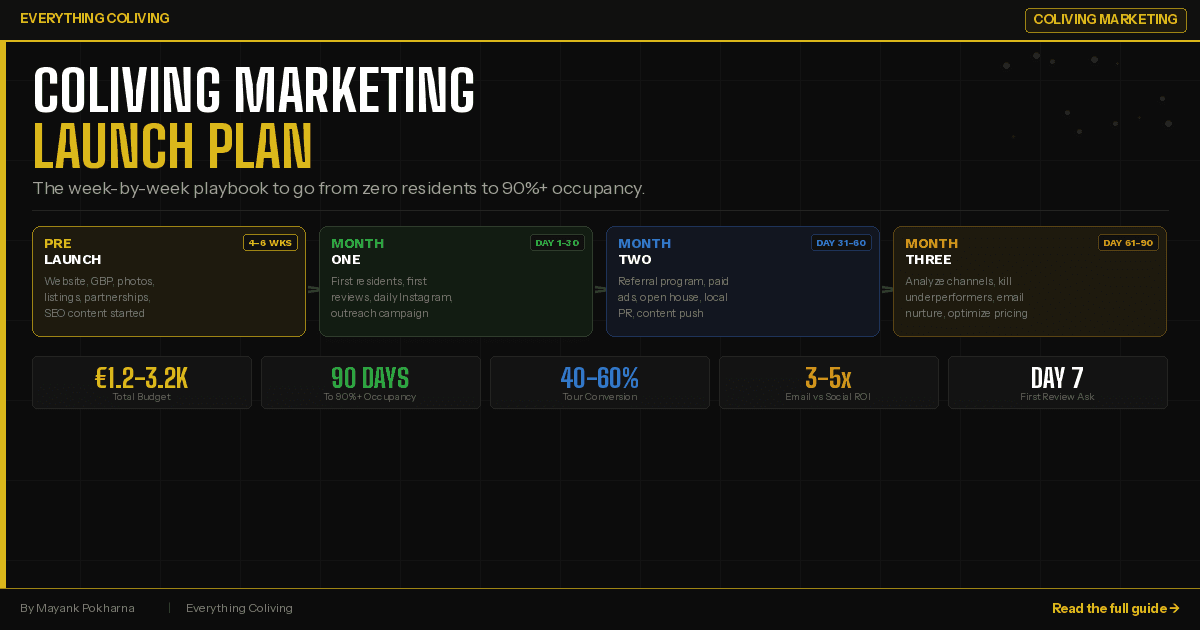
Coliving Marketing Launch Plan: First 90 Days
A week-by-week marketing launch plan for new coliving spaces, covering pre-launch, months 1-3, channel strategy, and a budget of €1,500-€3,000 total.

Coliving in Asia-Pacific: Market Overview and Opportunities
Asia-Pacific is the fastest-growing coliving market globally. Explore key markets, consumer trends, and investment opportunities across the region.

Coliving vs Build to Rent (BTR): Which Model Delivers Better Returns?
A detailed comparison of coliving and build-to-rent investment models. Yields, operational complexity, resident demographics, and market outlook analyzed side by side.

The Coliving AI Visibility Gap: What an AI Model Actually Knows About 103 Cities
We publish city guides. 103 cities, at last count. So I ran a simple test. I asked an AI model to name the top ten coliving brands in each of those 103 cities. No web search. No browsing. Just what the model actually knows, which is the closest thing we have to a measure of what the industry has managed to write into the permanent record. That should have produced 1,030 names. It produced about 280.