Coliving Financial Model Walkthrough — Lisbon 20-Bed Example
A detailed financial model walkthrough for a 20-room coliving in Lisbon, including startup costs, monthly P&L, 3-year projections, sensitivity analysis, and key metrics.

Master leasing, revenue share, property ownership, and hybrid models - with real financial benchmarks, unit economics, and profitability analysis from 47+ global operators.
Last updated: April 2026 | Based on data from 60+ operators across 14+ countries
“Asset-light coliving models (master lease, management) represent 75% of operations globally” — Everything Coliving 2026 Industry Research
“Master lease operators achieve 15-25% operating margins vs 8-12% for traditional residential” — Savills Living Sectors Report 2025
“Hybrid ownership models deliver 20-30% higher IRR than pure-play master lease” — JLL Global Living Sectors Report 2025
Data sources: JLL Research, Savills Living Sectors, CBRE Flexible Living, Cushman & Wakefield Alternative Living, Everything Coliving 2026 Industry Research (500+ operator surveys).
Interactive calculators and tools to put these insights into action.
Estimate potential returns and payback periods for coliving.
Try it free →Compare lease, management, and ownership models side by side.
Try it free →Find the optimal pricing strategy for your coliving rooms.
Try it free →Build a comprehensive operating budget for your property.
Try it free →Operators Use Master Leasing
Average Occupancy Rate
Typical Operating Margins
Are Asset-Light Models
Your choice of business model determines everything: how much capital you need, your risk profile, growth trajectory, operating margins, and exit potential. Two coliving operators in the same city, serving the same audience, can have radically different financial outcomes based solely on their model choice.
Data from our 2025 Global Coliving Report reveals that 75% of coliving operators worldwide are asset-light - they don't own their properties. Master leasing dominates at 46.8%, followed by property ownership (25.5%), revenue share (21.3%), and hybrid/franchise (6.4%). Each model has distinct financial characteristics.
This guide goes deep into the numbers behind each model - EBITDA benchmarks, NOI analysis, cap rates, unit economics, and side-income strategies. Whether you're launching your first coliving space or evaluating expansion models, this is your financial playbook.
For a broader overview of launching a coliving business (concept, location, design, marketing, operations), see our Complete Coliving Guide. Need expert guidance? Our advisory team has helped 60+ operators build their financial models.

Based on data from 47+ operators across 20+ countries. Each model has distinct capital requirements, risk profiles, and return potential.
Rent buildings, sublease rooms
The most popular coliving model globally. You sign a long-term lease on an entire building (or floor) from a property owner, then renovate and sublease individual rooms to residents at a premium. You manage everything - renovation, furnishing, marketing, community, and operations. The spread between your lease cost and resident revenue is your margin.
Fixed lease cost provides predictable EBITDA once occupancy stabilizes above 75–80%. The key risk is lease obligations during low-occupancy periods.
Best for: First-time operators looking to validate their concept, and experienced operators seeking rapid multi-city expansion with controlled risk.
Operate on behalf of property owners
You bring the coliving brand, operational expertise, technology, and community programming. The property owner provides the building (often already furnished). Revenue or profit is split according to agreed terms - typically 15–30% to the operator, the rest to the owner. This is the lowest-risk entry model.
Focus on EBITDAR (before rent) since rent is the owner's responsibility. Operator margins are thinner but capital requirements are minimal, enabling rapid scaling.
Best for: Operators with strong brand and systems who want to scale without capital constraints. Ideal for hotel conversions and institutional partnerships.
Own the asset, capture full value
Buy or develop the property yourself. Maximum control over design, pricing, renovations, and long-term strategy. You capture both the operating income and the real estate appreciation. Higher returns but requires significant capital investment and carries real estate market risk.
Track NOI and cap rate. Coliving properties typically achieve 5–8% cap rates in major markets, 50–150 basis points above comparable multifamily due to premium pricing.
Best for: Investors and developer-operators with access to capital or financing, focused on long-term wealth building through real estate plus operations.
License your brand, expand through partners
Combine multiple models or license an established coliving brand to local operators. The franchisor provides brand, systems, training, and technology. The franchisee provides local market knowledge, capital, and day-to-day operations. Revenue is shared through franchise fees and royalties.
The franchisor's revenue is royalty-driven and highly scalable. The franchisee benefits from an established brand but sacrifices some margin to royalties.
Best for: Established brands ready for international expansion, and local entrepreneurs who want a turnkey coliving playbook.
For a broader overview of these models, see the Business Models section in our Complete Coliving Guide.
Our advisory team has helped 60+ coliving companies build financial models and secure funding across 14+ countries.
From EBITDA to cap rates - the KPIs that determine coliving success, drawn from our masterclass series and operator benchmarking data.
Earnings Before Interest, Taxes, Depreciation, and Amortization (and Rent). The primary measure of operational profitability for coliving operators.
10–25% EBITDA margin for mature operatorsAsset-light operators (master lease/management) focus on EBITDAR since rent is their largest cost. Property owners track standard EBITDA. Healthy EBITDAR margins range from 30–45% before rent costs. Investors use EBITDA multiples for operator valuation.
Total revenue minus all operating expenses, excluding debt service and capital expenditures. Critical for property valuation and investor returns.
40–60% NOI margin for well-operated propertiesNOI is the numerator in cap rate calculations. Coliving properties often achieve 15–25% higher NOI per square meter than traditional multifamily due to premium pricing and shared-space efficiency. Track NOI per bed for standardized benchmarking.
NOI divided by property value. Represents the expected annual yield on a coliving real estate investment, independent of financing.
5–8% in major markets, 8–12% in emerging marketsColiving cap rates tend to be 50–150 basis points above comparable multifamily in the same market, reflecting both higher income potential and operational complexity. Lower cap rates indicate lower risk and higher property values.
Average monthly rate multiplied by occupancy rate. Borrowed from hospitality, increasingly used in coliving for performance tracking.
$500–$2,500/month depending on marketRevPAR captures both pricing power and occupancy in a single metric. Track RevPAR month-over-month to reveal seasonality patterns, pricing optimization opportunities, and competitive positioning.
Percentage of available rooms or beds occupied at any given time. The single most important operational KPI.
93% average among established operatorsBreak-even typically requires 70–80% occupancy. Above 90% indicates strong market-product fit. Track net occupancy (accounting for rent-free periods and maintenance gaps) alongside gross occupancy.
Total marketing and sales spend divided by new residents acquired in a given period.
Target CAC below 1 month's rentHigh-performing operators achieve CAC below 0.5x monthly rent through strong brand, referrals, and SEO. Paid channels typically cost 2–3x organic CAC. Track CAC by channel to optimize your marketing mix.
Understanding where your money comes from and where it goes is essential for building a sustainable coliving business. These benchmarks are based on a typical master lease operation.
| Source | % of Revenue |
|---|---|
| Room / bed rental income | 85–90% |
| Common area events & memberships | 3–5% |
| Side-income streams (laundry, parking, vending) | 2–5% |
| Administrative fees & late charges | 1–3% |
| Category | % of Revenue |
|---|---|
| Rent / mortgage (master lease model) | 40–55% |
| Staff & community management | 10–15% |
| Utilities (included in rent) | 8–12% |
| Maintenance & cleaning | 5–8% |
| Marketing & customer acquisition | 3–7% |
| Technology & software | 2–3% |
| Insurance & legal | 2–3% |
| Furnishing depreciation / replacement | 3–5% |
15–30%
Master Lease
8–15%
Management Agreement
25–45%
Owned Property
For a complete walkthrough of building your financial model, see Step 4: Build Your Financial Model in our Complete Coliving Guide.
Beyond room rental, smart operators generate 10–20% additional revenue through diversified income streams.
Open shared workspaces to non-residents during daytime hours. Particularly effective in locations near business districts.
Rent common areas for workshops, meetups, and private events during off-peak hours.
Coin-operated or subscription laundry. Low maintenance, steady passive income.
Sublease parking spots individually in urban areas. Can be significant in car-dependent markets.
Commission arrangements with nearby gyms, cafes, coworking spaces, and experience providers.
Dedicated rooms or floors for corporate relocations and team retreats at higher nightly rates.
A side-by-side comparison of the four core coliving business models across key dimensions.
| Dimension | Master Lease | Revenue Share | Ownership | Hybrid / Franchise |
|---|---|---|---|---|
| Capital Required | $50K–$150K | $20K–$50K | $500K+ | Variable |
| Operating Margin | 15–30% | 8–15% | 25–45% | 10–20% |
| Break-Even | 6–12 months | 3–6 months | 18–36 months | Market-dependent |
| Scalability | High | Very High | Low–Medium | Very High |
| Operational Control | Full | Shared | Full | Partial |
| Risk Level | Medium | Low | High | Medium |
| Equity Upside | None | None | Full | Brand equity |
| Best Entry Point | 1st property | Experienced ops | $500K+ capital | Established brand |
Your ideal model depends on your capital, experience, risk appetite, and growth ambitions.
All the financial benchmarks, business model data, and operator metrics referenced in this guide - from 47+ operators across 20+ countries.
Learn from the patterns we've seen across 60+ coliving operators worldwide. These are the most common pitfalls that derail otherwise promising ventures.
Master lease demands high upfront capital and works best in stable rental markets, while asset-light franchise models struggle in tight supply zones where landlords have leverage. Match your model to local supply-demand dynamics before you sign anything.
A 3-5% annual rent increase compounds to 16-28% over five years, but most first-time operators model their P&L as if rent stays flat. Always cap escalation at CPI or negotiate fixed step-ups tied to occupancy milestones.
Fixed rent feels simpler but caps your upside entirely in hot markets where rates climb 10-20% annually. A 70/30 revenue share above a floor protects the landlord and lets you capture growth — most landlords will accept if you frame it right.
Operators typically need 3+ properties and 200+ beds before centralized systems, CRM investments, and dedicated ops hires pay off. Scaling overhead on a single property burns cash and pulls focus away from community quality.
Tenancy rights, notice periods, and licensing regimes vary dramatically — the UK's HMO rules, Germany's Mietpreisbremse, and Spain's LAU all reshape which model is even viable. Never copy a structure across borders without local counsel.
Occupancy dropping from 92% to 70% can wipe your entire margin overnight, especially under master lease obligations. Stress-test every deal at three occupancy levels before committing capital or signing.
Anonymized examples from our advisory work with coliving operators across 14+ countries.
European capital
A first-time operator locked in a 10-year master lease without a break clause on a 48-bed property. When the market softened 18 months in and occupancy dipped to 74%, they couldn't exit without losing €300K in cumulative rent obligations. A 3-year break clause would have saved the business.
Southeast Asian hub
An operator pivoted from master lease to a management contract model across their 140-bed portfolio, reducing balance-sheet risk exposure by roughly 70% while retaining 80% of the upside through a performance-linked fee structure. It became the template for their next five openings.
North American college town
A hybrid ownership-plus-management model on a 62-bed asset delivered 23% IRR versus the projected 14% by capturing both stabilized rental income and a mid-cycle appreciation exit. The dual revenue stream gave the GP optionality most pure-lease operators never have.
Actionable insights from 11+ years of coliving advisory work.
Always negotiate break clauses in master lease agreements. Even a penalty equal to 30% of remaining rent obligation is better than being locked in when a market turns — we've seen operators lose entire businesses because they skipped this one clause for a 2% rent reduction at signing.
Model at least three occupancy scenarios before any commitment: 95% best case, 85% base, and 70% stress. If the deal only pencils at your best case, it isn't a deal — it's a bet. Your downside case should still service debt and leave you operating.
Revenue share models work best in markets with expected rent growth above 15% and low regulatory caps. In stable or rent-controlled markets, fixed-rent master leases with CPI escalators almost always outperform share structures once you run a 5-year horizon.
Management contracts are the most underrated model in the industry. Low capital risk, faster portfolio scaling, and landlord-aligned incentives mean operators can hit 10+ properties in 24 months versus 36-48 months under pure master lease — the trade-off is lower per-unit margin.
Don't mix business models within a single portfolio entity. It confuses investors during diligence, complicates reporting, and forces you to build two operating playbooks. Spin mixed models into separate SPVs or sub-brands so each has clean unit economics.
Review your business model every 12-18 months against local market conditions. Models that worked in 2021 cheap-debt environments often break in 2024-2026 rate cycles — build model review into your annual board cadence, not as a reactive exercise.
Get legal review from a local specialist in every jurisdiction before signing. Never copy a lease template across borders — we've seen €500K+ of avoidable errors from operators who assumed UK HMO structures would work in Portugal or Germany.
Deep-dive articles on coliving investment, fundraising, and financial strategy from industry experts.
A detailed financial model walkthrough for a 20-room coliving in Lisbon, including startup costs, monthly P&L, 3-year projections, sensitivity analysis, and key metrics.
A comprehensive guide to coliving business valuation methods including income approach, EBITDA multiples, replacement cost, and worked examples for operators and investors.

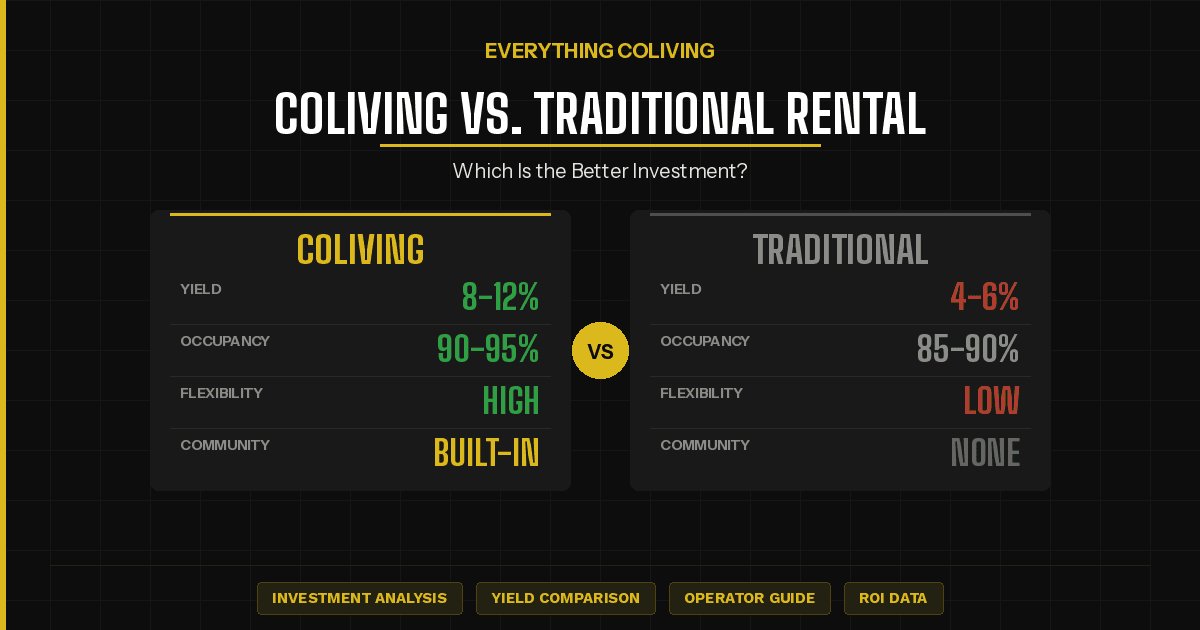
Compare the financial returns, risks, and operational demands of coliving investments against traditional buy-to-let properties.
Regional salary benchmarks for every coliving role including community managers, operations managers, cleaning staff, and maintenance, with compensation structures and benefits.
A strategic guide for coliving operators on when and how to raise rent, including communication templates, justification strategies, and handling pushback.
Actionable strategies for coliving operators to reduce operating costs by 15-30% across utilities, cleaning, technology, furnishing, and staffing.

Maximize your tax savings with this guide to deductions specific to coliving operators, from furnished unit depreciation to community event expenses.

Coliving properties face unique insurance challenges. Learn about the policies you need, common coverage gaps, and how to protect your business.

Scaling too early kills coliving businesses. Learn the financial, operational, and market signals that indicate you are ready to open your next property.

Learn dynamic pricing, tiered room strategies, and ancillary revenue tactics that top coliving operators use to maximize their revenue per bed.

Your lease agreement sets the legal foundation for your coliving business. Learn the essential clauses, common pitfalls, and best practices for coliving-specific leases.

Break down the unit economics of a coliving business. Revenue per bed, cost structure, break-even analysis, and how to model profitability at different scales.

A detailed comparison of coliving and build-to-rent investment models. Yields, operational complexity, resident demographics, and market outlook analyzed side by side.

Compare coliving and student housing business models. Understand the operational, financial, and demographic differences that matter for your investment decision.

Navigating insurance for coliving properties is complex. This guide covers the essential policies, common gaps, cost benchmarks, and how to avoid expensive mistakes.

A step-by-step guide to conducting a coliving feasibility study. Learn the financial analysis, market assessment, and site evaluation frameworks used by successful operators.
A detailed comparison of coliving and HMO investments in the UK market, covering returns, regulations, operational requirements, and which model suits different investor profiles.

A practical guide to calculating returns on coliving investments. Covers cap rates, cash-on-cash returns, IRR, and the key financial metrics every coliving investor needs.
A guide to crafting compelling investment pitches for coliving businesses, covering what institutional investors look for, deck structure, financial modeling, and common mistakes.

Understand coliving startup costs, expected yields compared to rental apartments, and the financial framework for evaluating coliving investment opportunities.
A clear explanation of the key financial metrics every coliving operator should track: CPOR, ADR, RevPAR, NOI, EBITDA, and how to calculate and benchmark each one.
A technical guide to modeling Debt Service Coverage Ratio (DSCR) for coliving bank loans, including lender requirements, stress testing, and financial model templates.

Compare the top coliving revenue models - from all-inclusive pricing to tiered memberships and hybrid approaches. Data-driven analysis to help you maximize RevPAB.
Comprehensive cap rate data for coliving investments across 20+ cities in Europe, Asia-Pacific, and the Americas, with analysis of trends and yield expectations.
Learn how to structure and price all-inclusive coliving packages that cover rent, utilities, WiFi, cleaning, events, and amenities while maintaining healthy margins.
If you came to this article directly, consider going through the series of articles it is a part of. Please find the link to the other articles in the...

If you came to this article directly, consider going through the series of articles it is a part of. Please find the link to the other articles in the...

If you came to this article directly, consider going through the series of articles it is a part of. Please find the link to the other articles in the...
BookMyColiving.com is a free platform for coliving operators to list their spaces, generate qualified leads, and grow profitably. No commissions, no listing fees Just direct connections with travelers and remote workers looking for their next coliving home.
Calculate your coliving investment returns
Download our coliving financial model
Ready-to-use investor pitch deck
Real business model case studies
Key industry data and benchmarks
Frequently asked questions answered
Our advisory team has helped 60+ coliving companies build financial models, choose the right structure, and secure funding across 14+ countries.
Monthly masterminds, weekly updates, and networking with coliving operators worldwide.