

When to Scale Your Coliving Business: Signs You Are Ready to Expand

Reviewed for accuracy
Mayank Pokharna, founder of Everything Coliving, reviewed this article. Basis of expertise: 13+ years operating and researching coliving; advisory work with 60+ operators across 14+ countries; primary source data from the EC operator dataset (500+ surveys). Financial and regulatory figures cross-referenced with JLL, CBRE, Cushman & Wakefield, and Knight Frank published research.
When to Scale Your Coliving Business: Signs You Are Ready to Expand
The coliving industry is full of operators who scaled too fast and crashed, and operators who waited too long and missed their window. Timing your expansion is one of the highest-stakes decisions you will make. Get it right, and you build a sustainable portfolio. Get it wrong, and you risk everything you have built.
Financial Readiness Signals
Consistent Profitability
Your existing property should be consistently profitable, not just breaking even. "Consistently" means at least 6 months of positive cash flow after all expenses, including your own salary.
Benchmarks:
- Net operating margin above 15%
- Occupancy consistently above 85%
- Rent collection rate above 97%
- Positive cash flow for at least 6 consecutive months
Adequate Cash Reserves
Opening a new property requires capital for security deposits, renovations, furnishing, marketing, and operating costs before revenue stabilizes. You need 6-12 months of operating expenses for the new property in reserve, plus an emergency fund for your existing property.
Access to Capital
Whether through retained earnings, debt, or equity, you need a clear funding path. Successful second-property funding often comes from a combination of cash flow from property one, a small business loan or commercial mortgage, and angel or institutional investors who have seen your track record.
Operational Readiness Signals
Documented Processes
If your operations depend on you personally being there, you are not ready to scale. Before expanding, you need documented standard operating procedures for every major function, a community manager who can run your property independently, technology systems that work without manual intervention, and vendor relationships that can be replicated.
Team Capacity
Scaling means your attention will be split. You need a property manager or community manager at your existing property who does not need daily supervision, administrative support for accounting, communications, and resident services, and a maintenance response system that works without you.
Proven Unit Economics
You should be able to articulate exactly how much it costs to acquire a resident, how much it costs to operate per bed per month, what your average revenue per bed is, and what your resident lifetime value is. These numbers guide your expansion strategy and help you evaluate new opportunities.
Market Signals
Demand Validation
Do not expand into a market on gut feeling. Validate demand through waitlist data from your existing property, search volume for coliving in the target market, competitor occupancy rates, and demographic trends showing growth in your target resident profile.
Competitive Landscape
Some competition is healthy. It validates the market. But entering a market where established operators have excess capacity is risky. Look for markets where demand exceeds supply, existing options are low quality, and you can differentiate meaningfully.
Expansion Models
Model 1: Same City, Second Property
Lowest risk. You know the market, have local relationships, and can share resources across properties.
Model 2: New City, Same Concept
Medium risk. Your brand and playbook transfer, but you need to learn a new market, build new vendor relationships, and potentially adapt to different regulations.
Model 3: Management Contracts
Lowest capital requirement. Manage properties for owners who provide the real estate. You provide the brand, operations, and residents.
Model 4: Franchise or License
Most scalable. License your brand and operating model to local operators. Requires a very mature brand and comprehensive operations manual.
The Pre-Expansion Checklist
Before signing any lease or purchasing any property, ensure these are complete:
- Financial model showing break-even within 12 months
- Market research with demand validation
- Funding secured with 20% buffer
- Team identified and onboarded
- Technology platform ready for multi-property management
- Legal structure reviewed for multi-entity operations
- Brand strategy for the new property
- Community manager hired 60 days before opening
- Marketing pipeline generating leads 90 days before opening
- Existing property operating independently
Warning Signs to Pause
- Your first property occupancy has dropped below 85%
- You are personally covering shifts or tasks regularly
- Your cash reserves are below 3 months of operating expenses
- You have not documented your core processes
- You are motivated primarily by ego rather than data
Free Newsletter
Join 37,000+ coliving professionals
Weekly insights on operations, marketing, and growth, delivered to your inbox.
The Bottom Line
Scale when your first property runs itself, your finances are solid, and the market data supports expansion. The best time to open your second property is when you could comfortably wait another year but the data tells you not to.
Stage gates for scaling a coliving business
From the EC operator dataset, the operators who scaled well and the ones who scaled badly are distinguishable by whether they passed through five specific stage gates before opening property #2. The operators who skipped gates universally regretted it, usually within 12 months.
- Gate 1: One full year of stabilized operations. 90%+ occupancy sustained for 6+ months, full operating cycle (winter and summer) observed, churn patterns understood. Operators who scaled before this consistently underestimated seasonality.
- Gate 2: A documented operating system. Written SOPs for the 20-30 recurring workflows (move-in, move-out, cleaning, maintenance ticketing, complaint resolution, community programming). If your operation is in your head, you can't replicate it.
- Gate 3: A management layer that isn't you. A community manager or property manager who can run the property without daily founder intervention for at least 30 days. The number of operators who tried to run two properties as the daily CM and burned out is uncomfortably high.
- Gate 4: Positive contribution margin, not just occupancy. Properties at 95% occupancy can still lose money. The gate is contribution margin above 20-25% (after all property-level opex, before corporate overhead).
- Gate 5: A repeatable acquisition channel. At least one channel producing 40%+ of leads consistently for 6+ months, with known CAC and known LTV. If you don't know how members will find property #2, you'll fall back on OTAs, and the margin won't work.
The 4-property / 200-bed inflection
From operator interviews, the most consistent observation about coliving scaling is the existence of a clear inflection around 4 properties or 200 beds. Below that, operators run on heroics and informal coordination; above it, they require real systems and management depth. Operators who hit this inflection unprepared report 12-18 months of painful rebuilding, replacing PMS, hiring a head of operations, formalizing finance, often turning over their original CMs.
The components that need to be in place by the time you cross the inflection:
- A real CFO function (full-time or fractional) producing monthly close, cash forecast, per-property P&Ls
- A head of operations who isn't the founder and who has authority to set standards
- A consolidated PMS capable of multi-property reporting
- A consolidated payments and billing setup with reconciliation discipline
- A documented hiring playbook for community managers, including comp benchmarks, scorecards, and onboarding
- A real CRM that survives more than one team member's preferences
Single market depth vs. multi-market spread
The strategic question operators consistently wrestle with at the 2-3 property stage is whether to deepen in their first market or spread to a second. From the EC operator dataset, the data is clear: operators who hit 4+ properties in a single market before opening in a second have meaningfully better unit economics by year 5 than operators who diversified geographically early.
The mechanism is mundane: in a single market you can share supply chains, contractors, leadership, marketing creative, and brand awareness across properties. Each new property in your home market has 30-40% lower opening cost than the first because you've already paid the discovery cost. Each new property in a new market pays most of those costs again.
The exception is when your first market has a clear ceiling, small city, regulatory hostility, capital cost too high to scale further. In those cases, geographic diversification is forced. But operators who diversified out of optimism rather than necessity universally report wishing they'd gone deeper at home first.
Lease vs. management vs. own: scaling implications
The structural choice of how you take on properties has massive scaling implications. From the EC operator interviews:
- Straight lease (you sign as tenant): Fastest to scale, highest capital efficiency, highest operating risk. Each property is a real liability. Works best when you have strong cash position and stable demand.
- Management agreement (owner retains lease risk): Slowest to negotiate, lowest capital risk, lower upside. Works best when you have strong operating brand and want to grow without putting capital at risk.
- Hybrid (revenue share with minimum guarantee): Increasingly common. Aligns landlord and operator more cleanly than either pure structure.
- Own (you or your fund own the building): Slowest, most capital-intensive, but the only structure that captures real estate appreciation. Most large operators end up here for their best properties even if they started with leases.
Operators who scaled with a single structure across all properties report flexibility issues; operators who mixed structures intentionally, leases in test markets, ownership in proven markets, management agreements in opportunistic locations, report better long-term economics.
The cash-flow trap of fast scaling
The most common scaling failure mode in the EC operator dataset isn't strategic, it's cash-flow. Every new property opens with 4-6 months of negative contribution margin during ramp, plus 2-4 months of upfront capex (furniture, deposits, marketing, brand work). An operator opening 4 properties in 12 months can easily burn $400,000-$1,000,000 in working capital before any of them stabilize.
The discipline that prevents this trap is straightforward but rarely practiced: don't open the next property until the previous one has hit positive cash flow, OR until you have explicit reserved capital for 9 months of ramp on the new one without relying on the cash flow of stabilized ones. Operators who broke this discipline and survived report doing so by luck, not by skill.
Knowing when to stop scaling
The unfashionable but consistent observation from mature operators is that some businesses shouldn't scale past a certain size. Some operators have found their best-fit scale at 1-3 properties, deliver exceptional product, and have happy lives and good margins. Other operators are built for 50+ properties. Conflating the two, assuming every operator should aspire to be the biggest, has cost the sector more capital and more good operators than any other single mistake.
Written by
Mayank Pokharna
Mayank Pokharna is the founder of Everything Coliving. 13+ years in coliving as an operator, PMS builder (JumboTiger, SimplyGuest), and advisor to 60+ operators advised across 14+ countries. Listed as a coliving expert on co-liv.org, featured in Forbes India, BBC Punjabi, Financial Express, and Economic Times, and published on the economics of shared living.
Explore Related Topics
Free Tools
Further Reading
Related Articles
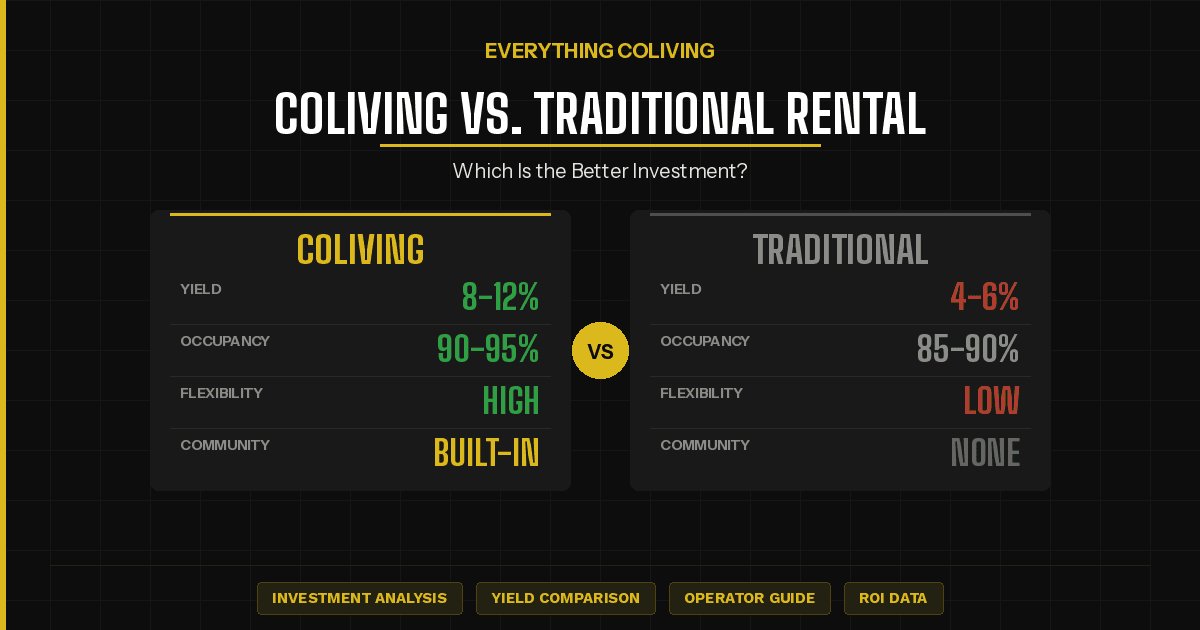
Coliving vs. Traditional Rental: Which Is the Better Investment?
Compare the financial returns, risks, and operational demands of coliving investments against traditional buy-to-let properties.

Coliving in Asia-Pacific: Market Overview and Opportunities
Asia-Pacific is the fastest-growing coliving market globally. Explore key markets, consumer trends, and investment opportunities across the region.
The Future of Coliving: 10 Trends Shaping the Industry Through 2030
Where is coliving headed? From AI-powered operations to intergenerational communities, explore the trends that will define the next era of shared living.

Coliving Pricing Strategies: How to Maximize Revenue Per Bed
Learn dynamic pricing, tiered room strategies, and ancillary revenue tactics that top coliving operators use to maximize their revenue per bed.

Revenue Per Available Bed (RevPAB): The Key Metric for Coliving Operators
Learn how to calculate, benchmark, and improve Revenue Per Available Bed (RevPAB), the essential performance metric for coliving operators.