

How to Price All-Inclusive Packages (Rent + Bills + Amenities)

Reviewed for accuracy
Mayank Pokharna, founder of Everything Coliving, reviewed this article. Basis of expertise: 13+ years operating and researching coliving; advisory work with 60+ operators across 14+ countries; primary source data from the EC operator dataset (500+ surveys). Financial and regulatory figures cross-referenced with JLL, CBRE, Cushman & Wakefield, and Knight Frank published research.
Why All-Inclusive Pricing Works for Coliving
All-inclusive pricing is one of coliving's strongest competitive advantages against traditional rentals. Residents love the simplicity of one payment covering everything, no surprise utility bills, no negotiating WiFi contracts, no separate cleaning costs. For operators, all-inclusive pricing simplifies billing, reduces late payments, and creates a premium perception that supports higher total rent.
What to Include in Your All-Inclusive Package
Tier 1: Standard Inclusions (Expected by All Residents)
- Room rent (private bedroom or bed in shared room)
- All utilities (electricity, gas, water, heating)
- High-speed WiFi (minimum 100Mbps, ideally 1Gbps)
- Common area cleaning (2-3x per week)
- All furnishings (bed, desk, wardrobe, storage)
- Bed linens and towels (with regular laundry service)
Tier 2: Premium Inclusions (Differentiators)
- Private room cleaning (weekly or bi-weekly)
- Laundry service or access to on-site machines
- Community events (2-3 per week)
- Coworking space access
- Basic gym/fitness equipment
- Kitchen consumables (cooking oil, spices, coffee, tea)
Calculating Your All-Inclusive Price
Use this formula: All-Inclusive Price = (Total Fixed Costs / Beds × 1.15) + Variable Cost per Bed + Target Margin
The 1.15 multiplier accounts for vacancy (assuming 85% target occupancy). Use our break-even calculator to model specific scenarios and our room pricing calculator to benchmark against local market rates.
Managing Utility Cost Risk
All-inclusive means you absorb utility cost volatility. Mitigate this by: installing smart meters to monitor consumption, setting usage guidelines in house rules, using our utility cost splitter to understand per-bed costs, and budgeting 10-15% above average utility costs as a buffer.
Frequently Asked Questions
Should I charge different prices for different room sizes?
Yes. Price differentials of 15-30% between your smallest and largest rooms are standard. Ensuite rooms command a 20-35% premium over shared-bathroom rooms.
How do I handle residents who use excessive utilities?
Set reasonable fair-use guidelines in your house rules. For outliers (e.g., space heaters running 24/7), address individually rather than penalizing everyone. Smart plugs can help monitor room-level consumption.
Should I offer a bills-excluded option?
Generally no. All-inclusive is a key differentiator for coliving. However, for long-stay residents (6+ months), offering a slightly discounted "bills-excluded" option can be attractive to price-sensitive tenants who are careful with consumption.
How to break down what "all-inclusive" should cost the operator
All-inclusive coliving packaging looks simple to the tenant ("one price, everything included") but requires careful unbundling on the operator side. Get the bundling wrong and you either undercharge (margin compression) or overcharge (slow lease-up). The math:
The 6 inclusion layers and their cost
- Base rent - 70-80% of all-inclusive price
- Utilities (electric, gas, water, internet) - €40-90/bed/mo Western Europe; $50-130 NA
- Cleaning of common areas - €30-70/bed/mo
- Community programming + events - €15-40/bed/mo
- Furnishing amortization - €25-60/bed/mo (3-5 year depreciation)
- Software, supplies, ops overhead - €20-40/bed/mo
Pricing strategy approaches
Cost-plus: Total all-in cost × (1 + target margin). Simple but ignores willingness-to-pay.
Value-based: Price = comparable furnished apartment + 10-25% premium. Assumes tenant values the bundling. Works in markets where setup-cost-savings are meaningful.
Hybrid (most operators): Set base rent at value-based level, ensure margin clears cost-plus floor. If they conflict, the cheaper market usually wins - meaning you discount.
Free Newsletter
Join 37,000+ coliving professionals
Weekly insights on operations, marketing, and growth, delivered to your inbox.
What to NOT include in all-inclusive (premium add-ons)
- Premium cleaning (in-room weekly cleaning)
- Pet allowance
- Parking
- Storage
- Premium meal plans (in markets where bundled food is optional)
- Late checkout / extended stay
Pricing these as add-ons captures higher-paying tenants without raising the base rate.
Common all-inclusive pricing mistakes
- Bundling food into base when local market doesn't expect it - locks in operating cost without willingness-to-pay support
- Not pricing utility variability into the base - hot summers / cold winters can swing 5-10% of margin
- Below-market base rate to compete on "all-inclusive" - destroys margin
Related resources
- Pricing models
- Pricing optimizer: Pricing Optimizer
All-inclusive pricing: the cost stack you must rebuild monthly
The single largest mistake operators make on all-inclusive packages is treating the cost stack as static. Energy, food, internet and cleaning costs all move on different cycles, and EC operator dataset shows median margin compression of 280 to 520 bps over an 18-month period when packages are repriced only annually. The fix is a rolling 30-day cost recalc against actual consumption, not a budget number set in a spreadsheet in January.
Your inclusive package must be reverse-engineered from a per-bed monthly cost line, not a building-level total divided by beds. Otherwise you under-recover on premium tier rooms that pay the same utilities allowance as standard rooms but consume 1.6 to 2.2x the kWh.
| Cost line | % of all-in package (urban EU/US) | % of all-in package (India) |
|---|---|---|
| Base rent / landlord cost | 52-62% | 40-50% |
| Utilities (elec, gas, water) | 7-12% | 5-9% |
| Internet and tech | 1-2% | 1.5-2.5% |
| Cleaning and laundry | 4-7% | 3-5% |
| F&B (if included) | 0% or 14-20% | 15-22% |
| Maintenance reserve | 2-4% | 2-4% |
| Insurance and licences | 1-3% | 1-2.5% |
| Target gross margin | 22-32% | 20-30% |
The four pricing architectures, and when each works
- Flat all-inclusive: simplest to sell, highest margin compression risk. Works in mature, low-volatility markets where energy prices are regulated (parts of France, Spain, India tier-2). Build in a 6 to 9 percent buffer on the utility line.
- All-inclusive with fair-use caps: package covers consumption up to a defined kWh, GB, laundry-load or guest-night threshold, with metered overage. EC operator data shows this recovers 4 to 7 percent of opex versus pure flat pricing while keeping the marketing message clean.
- Modular pricing: base rent plus an opt-in services bundle (cleaning, F&B, gym, coworking). Higher pricing transparency, lower conversion rate (typically 12 to 18 percent lower) but 15 to 25 percent higher gross margin on the services attached.
- Hybrid with seasonal flex: base flat package with quarterly true-ups against a utility index (UK Ofgem cap, EU PVPC reference, US PJM/ERCOT). Used by larger institutional operators to keep underwriting models defensible.
The math: how to actually price a bed
Start with a true delivered cost per bed per month, including landlord rent allocated by area-weighted plus amenity-weighted shares. Layer the variable cost stack at projected occupancy (do not use 100 percent, use your stabilised ramp number, typically 88 to 93 percent). Add the target contribution margin. Then sense-check against market comparables for the same bed type, not just the building average.
Worked example for a 90-bed urban coliving asset in a Tier 1 EU market: average delivered cost per bed per month is EUR 740. Variable utilities and services at 90 percent occupancy add EUR 165. Target gross margin of 28 percent means a price floor of approximately EUR 1,255 per bed per month, with premium rooms priced 14 to 22 percent higher to reflect amenity allocation and natural light premium.
Common modelling errors that flatter the package margin
- Using building-average utility costs rather than per-bed metered or estimated draw. Premium rooms with private bath and aircon can consume 80 to 130 percent more than standard rooms.
- Forgetting the seasonal cost wedge. EU heating costs in Q1 can be 3 to 5x summer levels, so an annual average buried in a flat package destroys Q1 cash flow.
- Ignoring tenant churn cost. Each turn costs EUR 180 to 420 in cleaning, repair and admin time. Packages with shorter average tenure must price the turn cost back into the headline rate.
- Underweighting bad debt and discount leakage. Stabilised operators report 1.5 to 3.5 percent of GOI lost to discounts, comp nights and write-offs. Build it into the gross-to-net waterfall.
- Counting F&B as revenue while burying labour and food cost in opex. Food and beverage should be analysed as a standalone P&L within the building model, targeting 60 to 68 percent food cost plus 15 to 22 percent labour cost.
How to communicate price changes without churning your base
EC operator interviews show that mid-tenancy price increases of 4 to 7 percent are absorbed with under 8 percent churn, while increases of 12 percent or more push churn to 22 to 35 percent within 60 days. The recommended cadence is: anchor price increases at lease renewal, communicate 60 days in advance, justify with one specific cost line (energy, insurance, council tax) rather than a generic inflation message, and offer a 12-month price-lock option in exchange for an upfront renewal commitment. Operators using this playbook see 78 to 86 percent renewal-at-new-price conversion versus 55 to 65 percent on a one-line generic announcement.
What IC committees and lenders look for in pricing decks
Whether you are raising debt or equity, financial decks should show three views of pricing: contracted ARPU at building stabilisation, a downside scenario at 88 percent occupancy with a 6 percent ARPU haircut, and a sensitivity grid mapping NOI against ARPU and opex moves. Lenders increasingly request a 24-month rolling utility cost trace from comparable buildings, and equity ICs ask for a price-elasticity test (typically a 5 to 8 percent step test on a small bed cohort) before signing off on a 5-year financial model. If your pricing strategy is not testable, it is not investable.
Written by
Mayank Pokharna
Mayank Pokharna is the founder of Everything Coliving. 13+ years in coliving as an operator, PMS builder (JumboTiger, SimplyGuest), and advisor to 60+ operators advised across 14+ countries. Listed as a coliving expert on co-liv.org, featured in Forbes India, BBC Punjabi, Financial Express, and Economic Times, and published on the economics of shared living.
Explore Related Topics
Free Tools
Further Reading
Related Articles

Coliving Lease Agreements: What to Include and What to Avoid
Your lease agreement sets the legal foundation for your coliving business. Learn the essential clauses, common pitfalls, and best practices for coliving-specific leases.

When to Scale Your Coliving Business: Signs You Are Ready to Expand
Scaling too early kills coliving businesses. Learn the financial, operational, and market signals that indicate you are ready to open your next property.

Coliving Pricing Strategies: How to Maximize Revenue Per Bed
Learn dynamic pricing, tiered room strategies, and ancillary revenue tactics that top coliving operators use to maximize their revenue per bed.

Coliving Feasibility Study: How to Analyze Your Project Before You Invest
A step-by-step guide to conducting a coliving feasibility study. Learn the financial analysis, market assessment, and site evaluation frameworks used by successful operators.
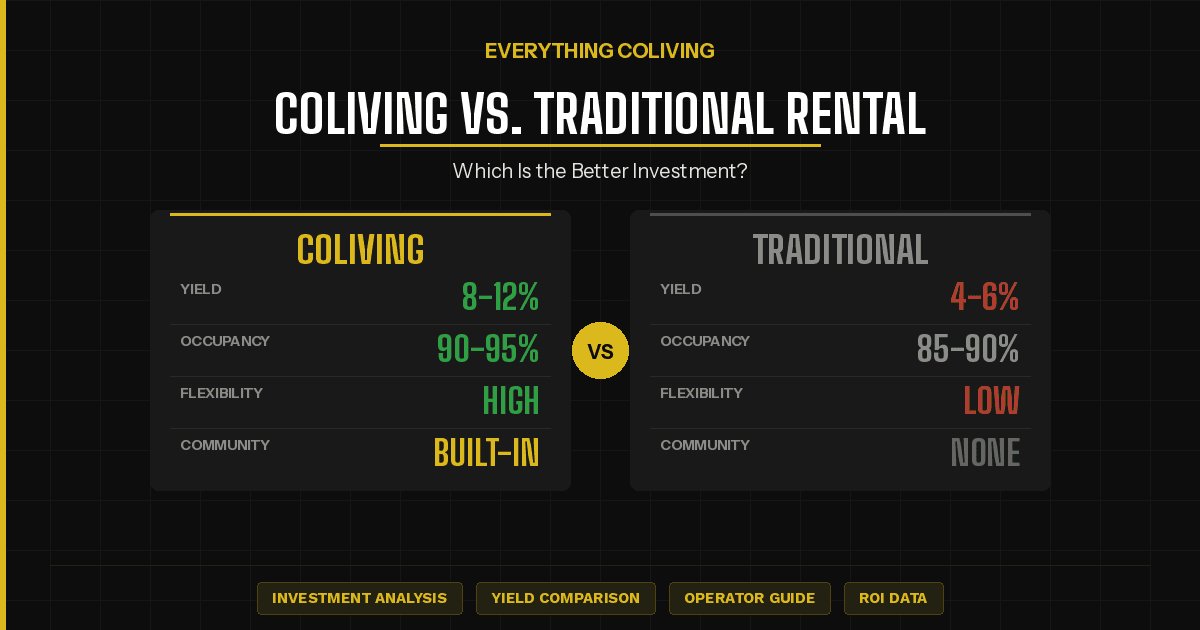
Coliving vs. Traditional Rental: Which Is the Better Investment?
Compare the financial returns, risks, and operational demands of coliving investments against traditional buy-to-let properties.