

Tax Deductions Every Coliving Operator Should Know

Reviewed for accuracy
Mayank Pokharna, founder of Everything Coliving, reviewed this article. Basis of expertise: 13+ years operating and researching coliving; advisory work with 60+ operators across 14+ countries; primary source data from the EC operator dataset (500+ surveys). Financial and regulatory figures cross-referenced with JLL, CBRE, Cushman & Wakefield, and Knight Frank published research.
Tax Deductions Every Coliving Operator Should Know
Coliving operators have access to deductions that traditional landlords do not, thanks to the furnished, service-rich nature of the business. Understanding these deductions can save you tens of thousands annually. While this guide provides general information, always work with a tax professional who understands your specific situation and jurisdiction.
Property-Related Deductions
Mortgage Interest
If you own the property, mortgage interest on your coliving property is fully deductible as a business expense. This is often one of the largest deductions available.
Property Taxes
Real estate taxes paid on your coliving property are deductible. Keep detailed records, especially if you operate in multiple jurisdictions.
Rent (for Leased Properties)
If you lease the property and operate it as coliving, the full lease payment is a deductible business expense. This is a significant advantage for the master-lease model.
Insurance Premiums
All insurance premiums related to your coliving operation are deductible, including property insurance, liability insurance, workers' compensation, and cyber liability coverage.
Repairs and Maintenance
Routine repairs and maintenance costs are immediately deductible. This includes plumbing and electrical repairs, painting, appliance repairs, pest control, and cleaning supplies.
Furnished Unit Deductions
Furniture Depreciation
Furniture and furnishings in coliving units are depreciable assets, typically over 5-7 years. This includes beds and mattresses, desks and chairs, sofas and common area furniture, and kitchen equipment.
Pro tip: Consider Section 179 depreciation, which allows you to deduct the full cost of qualifying assets in the year they are purchased, rather than depreciating over several years.
Technology and Equipment
Smart locks, WiFi routers, security cameras, laundry machines, and coworking equipment are all depreciable. Most technology assets depreciate over 5 years.
Linens and Supplies
Bedding, towels, kitchen supplies, and cleaning materials provided to residents are deductible as operating expenses. Track these carefully as they add up.
Operating Expense Deductions
Utilities
All utilities you provide are deductible: electricity, water, gas, internet, and cable or streaming services.
Community Programming
Event costs, including food and beverages for community dinners, workshop facilitator fees, activity supplies and materials, and entertainment and decorations are deductible as business expenses. These are often overlooked by operators who do not realize community events qualify as legitimate business expenses.
Software and Technology
Property management software subscriptions, accounting software, communication platforms, and marketing tools are all deductible.
Professional Services
Legal fees, accounting fees, property management consulting, and marketing agency costs are deductible business expenses.
Marketing and Advertising
Website hosting and development, social media advertising, photography and videography, listing fees on coliving platforms, and print materials are all deductible.
Personnel Deductions
Employee Compensation
Salaries, wages, and benefits for community managers, maintenance staff, cleaning crews, and administrative employees are fully deductible.
Independent Contractors
Payments to freelance cleaners, handypeople, event facilitators, and other contractors are deductible. Issue 1099 forms for payments exceeding $600 annually.
Training and Development
Costs for staff training, industry conferences, and professional development are deductible.
Often-Overlooked Deductions
Vehicle Expenses
If you use a vehicle for property management, maintenance runs, or supply purchases, track mileage or actual expenses for deduction.
Home Office
If you manage your coliving business from a home office, you may deduct a portion of your home expenses.
Travel
Travel to inspect potential new properties, attend industry conferences, or manage remote properties is deductible.
Bad Debt
Uncollectable rent from residents who have departed is deductible as a bad debt expense.
Startup Costs
If you are launching your first coliving property, up to $5,000 in startup costs can be deducted in the first year, with the remainder amortized over 15 years.
Tax Planning Strategies
- Entity structure matters. LLC, S-Corp, or C-Corp structures offer different tax advantages. Consult with a tax attorney about the optimal structure for your situation.
- Cost segregation studies. For properties you own, a cost segregation study can accelerate depreciation on building components, potentially saving tens of thousands in taxes.
- Quarterly estimated taxes. Pay quarterly to avoid penalties and manage cash flow.
- Keep impeccable records. Digital receipt tracking, categorized expenses, and organized financial statements make tax season smoother and ensure you capture every deduction.
Free Newsletter
Join 37,000+ coliving professionals
Weekly insights on operations, marketing, and growth, delivered to your inbox.
The Bottom Line
The coliving business model generates more deduction categories than traditional rentals. Working with a tax professional who understands both real estate and hospitality taxation ensures you capture every legitimate deduction while staying compliant.
The deductions most coliving operators leave on the table
Tax leakage is the single largest unforced error EC operator interviews surface across 30-plus coliving operators globally. Most leakage comes from missed capital allowance claims, mis-classified opex versus capex, and incorrect VAT or GST positions on bundled service revenue. The framework below highlights the deductions that typically move the after-tax IRR by 150 to 400 bps when correctly claimed.
Capital allowances and depreciation: jurisdiction by jurisdiction
| Jurisdiction | Typical qualifying capex | Annual deduction rate |
|---|---|---|
| UK (P&M and integral features) | 15-22% of new-build capex | 18% reducing balance / 6% special rate |
| UK structures and buildings | Non-residential portions only | 3% straight-line over 33.3 yrs |
| US Section 179 + bonus depreciation | Up to USD 1.16m + 60% bonus (2024) | Year-one expensing of qualifying FF&E |
| US residential 27.5-yr / commercial 39-yr | Building shell portion | 3.64% / 2.56% straight-line |
| India Section 32 depreciation | FF&E, IT, plant | 10-40% WDV by asset class |
| EU varies by member state | Plant, fittings, integral features | 5-25% straight-line / declining |
A cost segregation study, mandatory in the US for serious operators, typically front-loads 18 to 32 percent of total project capex into 5- and 15-year asset lives versus the default 27.5- or 39-year shell life. EC operator interviews suggest the study pays back in 3 to 9 months on assets above USD 4-5 million.
Operating expense categories most often misclassified
- Repairs vs improvements: replacing a worn carpet is opex; replacing all carpets with a new specification is likely capex. The IRS, HMRC and Indian Income Tax tribunal lines on this differ by country but the core test is whether the work restores existing function or enhances it.
- Software and tech: PMS, access control, IoT sensors are typically capitalised but qualify for accelerated depreciation under US Section 179, UK AIA, or Indian Section 32 at 40 percent WDV.
- Pre-opening expenses: marketing, recruitment, training spent before the building opens are capitalised in most jurisdictions and amortised over 60 months (US) or expensed in year one (UK, India under specific conditions). Tracking pre-opening separately preserves the option.
- Marketing: brand campaigns versus specific bed-fill campaigns are treated differently. Operators with clear cost coding capture 100 percent of the latter as current opex.
- Community manager and lifestyle programming: fully deductible operating expense, but operators sometimes capitalise it under "amenity build-out" which is incorrect once the building is operational.
VAT, GST and sales tax: where bundling destroys margin
The single most common mistake EC observes in coliving operator P&Ls is bundling rent and services into a single invoice line. This invites a tax authority to treat the entire revenue stream as standard-rated VAT or GST supply, eroding 12 to 18 percent of gross margin overnight. The correct approach is:
- UK: residential rent is VAT-exempt; services (cleaning, F&B, gym) are standard-rated at 20 percent. Split-invoice cleanly with a documented service charge schedule.
- EU: most member states treat long-stay residential as VAT-exempt, but short-stay (under 30-90 days, varies) as standard-rated hospitality at 7 to 22 percent. France, Germany, Spain and Italy each draw the line differently.
- India: residential dwellings for use as residence are GST-exempt; serviced accommodation is taxable at 12 to 18 percent. The CBIC clarifications of July 2024 are the controlling guidance.
- US: most states do not impose sales tax on long-term residential, but transient occupancy tax (TOT) and lodging taxes apply to stays below 30 days in many cities. Some jurisdictions (NYC, Chicago, San Francisco) have specific short-term rental rules with separate registrations.
Deductions tied to financing and capital structure
- Mortgage interest: fully deductible against operating income in most jurisdictions, but UK individual landlords are restricted to a basic-rate tax reducer under Section 24 unless held in a corporate SPV.
- Loan arrangement fees: amortised over the loan term in the UK and EU; capitalised and depreciated alongside the asset in the US.
- Interest rate hedge costs: deductible as financing expense but only if directly attributable to the financed asset.
- Refinancing costs: deductible at the time of refinancing in most jurisdictions, often missed when handled by a legal team rather than the finance function.
The annual tax hygiene checklist
- Run a capital allowance review on any building opened or refurbished in the last 5 years.
- Reconcile capex versus opex coding monthly, not annually. Quarterly review is the minimum standard for institutional-grade operations.
- Confirm VAT/GST treatment of each revenue stream with a written tax opinion every 24 months or when local rules change.
- Document staff time allocation across operating vs development activities to support deductibility.
- Maintain a fixed asset register with disposal dates to capture loss-on-disposal deductions promptly.
- For multi-jurisdiction operators, run an annual transfer pricing review to confirm intra-group management fees and brand licences are arm's-length.
- Pre-clear major positions with tax authorities through advance rulings where available; the cost is modest and the certainty is material.
Operators that build tax hygiene into the monthly close rather than into year-end scramble consistently report 200 to 350 bps better effective tax rates and materially better lender and investor diligence outcomes. The investment in a part-time tax-aware finance function pays back inside the first year on any asset above USD 3-4 million.
Written by
Mayank Pokharna
Mayank Pokharna is the founder of Everything Coliving. 13+ years in coliving as an operator, PMS builder (JumboTiger, SimplyGuest), and advisor to 60+ operators advised across 14+ countries. Listed as a coliving expert on co-liv.org, featured in Forbes India, BBC Punjabi, Financial Express, and Economic Times, and published on the economics of shared living.
Explore Related Topics
Further Reading
Related Articles

Fire Safety for Coliving: Regulations, Equipment & Compliance Guide
A comprehensive guide to fire safety regulations, required equipment, risk assessments, and compliance for coliving operators across the UK, US, and EU.

Coliving Insurance: What Operators Need to Know in 2026
A comprehensive guide to coliving insurance covering property, liability, contents, and business interruption policies, with cost estimates and provider recommendations.

How to Screen Tenants for Coliving: Background Checks & Best Practices
A complete guide to tenant screening for coliving operators, covering background checks, credit screening, reference checks, community fit assessment, and legal considerations.

Coliving Team Structure at Every Stage
A practical guide to building your coliving team from solo operator to multi-property scale, with org charts, hiring triggers, and outsource vs hire decisions.
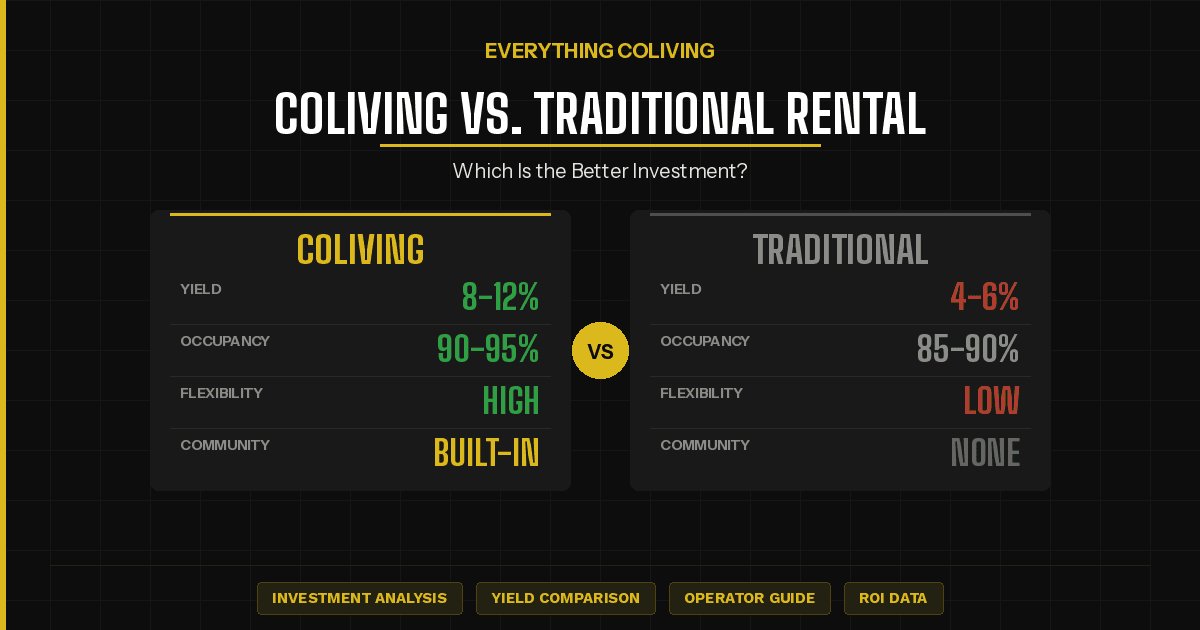
Coliving vs. Traditional Rental: Which Is the Better Investment?
Compare the financial returns, risks, and operational demands of coliving investments against traditional buy-to-let properties.