
Coliving Revenue Models: Which One Is Right for Your Business?

Reviewed for accuracy
Mayank Pokharna, founder of Everything Coliving, reviewed this article. Basis of expertise: 11+ years operating and researching coliving; advisory work with 60+ operators across 14+ countries; primary source data from the EC operator dataset (500+ surveys). Financial and regulatory figures cross-referenced with JLL, CBRE, Cushman & Wakefield, and Knight Frank published research.
The Revenue Model Defines Your Business
Your revenue model is not just about pricing - it shapes your operations, target market, resident experience, and ultimately your profitability. Choosing the right model early saves you from costly pivots later.
Let us break down the four primary revenue models used by successful coliving operators worldwide.
Model 1: All-Inclusive Pricing
How It Works: One monthly price covers rent, utilities, WiFi, cleaning, community events, and often amenities like coworking space.
Typical Price Range: $800-$2,500/month depending on market and room type.
Pros:
- Simple to communicate and sell
- Reduces billing complexity
- Residents love the predictability
- Higher perceived value
- Easier to compare against traditional rental + utilities
Cons:
- Harder to control utility costs
- Less flexibility for different resident needs
- May attract short-stay residents who are more cost-sensitive
- Margins can be squeezed if utility costs spike
Best For: Urban coliving targeting young professionals and remote workers. Properties with 20-50 beds.
RevPAB Benchmark: $900-$1,400/month in Tier 1 cities.
Model 2: Base Rent + Add-Ons
How It Works: A lower base rent covers the room and basic amenities. Residents pay extra for premium services like private bathroom, parking, laundry credits, or coworking desk.
Typical Structure:
- Base rent: $600-$1,200/month
- Private bathroom: +$150-$300/month
- Parking: +$100-$200/month
- Premium WiFi: +$30-$50/month
- Coworking desk: +$100-$200/month
Pros:
- Lower entry price attracts more leads
- Residents feel in control of their spending
- Higher margins on add-ons (often 60-80% margin)
- Better unit economics for larger properties
Cons:
- More complex billing and communication
- Risk of resident frustration with "nickel and diming"
- Requires more sophisticated PMS software
- Harder to market a single compelling price point
Best For: Larger properties (50+ beds) with varied room types and amenity levels.
RevPAB Benchmark: $850-$1,300/month (base + average add-on revenue).
Model 3: Membership Tiers
How It Works: Offer 2-3 membership levels with increasing benefits. Think of it like a SaaS subscription model applied to housing.
Example Tier Structure:
| Tier | Price | Includes |
|---|---|---|
| Essential | $800/mo | Room, WiFi, basic cleaning, common areas |
| Premium | $1,200/mo | + Private bathroom, weekly events, coworking |
| VIP | $1,800/mo | + Largest room, daily cleaning, guest nights, priority booking |
Pros:
- Clear upsell path increases average revenue per resident
- Residents self-select into price tiers
- Creates aspirational positioning
- Easier to fill beds at the lower tier while maximizing revenue at higher tiers
Cons:
- Can create a "two-class" dynamic in the community
- More complex operations (different service levels)
- Requires careful tier design to avoid cannibalization
- Marketing needs to clearly differentiate tiers
Best For: Purpose-built coliving with varied room types. Properties targeting a mix of budget-conscious and premium residents.
RevPAB Benchmark: $950-$1,500/month (blended across tiers).
Model 4: Hybrid - Stay Duration Pricing
How It Works: Price varies based on length of commitment. Shorter stays pay a premium, longer commitments get a discount.
Example Structure:
- 1-month stay: $1,800/month
- 3-month commitment: $1,500/month
- 6-month commitment: $1,200/month
- 12-month commitment: $1,000/month
Pros:
- Encourages longer stays (reduces turnover costs)
- Higher revenue per bed for short stays
- Appeals to both digital nomads and long-term residents
- Reduces vacancy risk with committed residents
Cons:
- Short-stay residents may disrupt community stability
- Higher operational costs for frequent turnovers at the short end
- More complex revenue forecasting
- May require different marketing channels for each segment
Best For: Properties in tourist-friendly or digital nomad cities (Lisbon, Bali, Barcelona). Mixed-use properties.
RevPAB Benchmark: $1,000-$1,600/month (blended across stay lengths).
How to Choose Your Revenue Model
Consider these factors:
Your target market: Young professionals want simplicity (all-inclusive). Digital nomads want flexibility (duration-based). Mixed markets need tiers.
Property size: Smaller properties (under 20 beds) benefit from all-inclusive simplicity. Larger properties can support tiered or add-on models.
Market positioning: Luxury coliving should use tiers or all-inclusive at premium pricing. Budget coliving should use base rent + add-ons.
Operational capacity: More complex models require better technology, more staff training, and stronger processes.
Local market norms: Research what competitors are doing and what residents expect in your market.
Revenue Optimization Strategies
Regardless of your model, these strategies boost RevPAB:
- Dynamic pricing: Adjust rates based on occupancy and demand seasonality
- Ancillary revenue: Laundry, vending, event space rental, parking
- Corporate partnerships: Offer bulk rates to companies relocating employees
- Event hosting: Charge for premium workshops and networking events
- Referral programs: Offer residents credit for successful referrals
The Bottom Line
There is no single "best" revenue model. The right choice depends on your market, property, and operational sophistication. Start with the simplest model that serves your target market, then add complexity as you learn what your residents value most.
Use our Coliving Financial Model template to model different revenue scenarios for your property.
Free Newsletter
Join 37,000+ coliving professionals
Weekly insights on operations, marketing, and growth, delivered to your inbox.
Coliving revenue models: the five structures and what each really costs
"Coliving revenue model" is shorthand for a bundle of choices: how rent is structured, how services are charged, which channels are primary, and how the operator captures upside. EC operator dataset identifies five distinct revenue models in active use, each with a different unit economics profile, capital intensity, and exit story.
| Model | Gross margin | Capital intensity | Best fit |
|---|---|---|---|
| Pure leasehold operator | 22-32% | Low (FF&E only) | Brand-led growth, multi-city expansion |
| Owned and operated | 40-58% | High (full asset) | Single-asset family office, REIT-style |
| Management agreement (HMA) | NOI share + fee | None (operator) | Institutional landlords, REITs |
| Franchise / brand licence | 4-9% royalty | Very low | Mature brand, capital-light expansion |
| Hybrid (mixed lease types) | 30-45% blended | Medium | Scaling operator, portfolio diversification |
Pure leasehold: the operator-led model
The dominant European model. Operator signs a 10 to 25 year master lease with a landlord, paying fixed rent (sometimes plus revenue share above a hurdle), and captures the gross-to-NOI margin. The lease is the largest opex line. Operator margin is high-variance: a strong stabilised building delivers 32 to 40 percent gross margin, a poorly leased or under-ramped building delivers single digits.
Pros: capital-light, fast geographic expansion, brand and product control. Cons: leasehold dilutes exit value (operator only owns the operating company, not the underlying real estate), and bad lease economics are nearly impossible to repair.
Owned and operated: the highest-margin, slowest-growth model
Operator owns the freehold (or long leasehold) and operates the building. Captures both the real estate return and the operating margin. The institutional preference where capital is available because exit value is materially higher: a stabilised owned-operated asset typically trades on a 5.25 to 6.50 percent cap rate, capturing both the property and the operating premium.
Capital intensity is the binding constraint. A 90-bed urban Tier 1 asset requires EUR 18 to 30 million of project cost. Most growing brands cannot self-fund this past 2 to 4 buildings without institutional equity. EC investor interviews suggest the natural answer is a JV with a real estate fund: the fund owns the asset, the brand operates under an HMA or revenue share.
Management agreement (HMA): the fee-business model
Operator runs the building on behalf of an institutional landlord under an HMA. Compensation is typically a base management fee (3 to 5 percent of total revenue) plus an incentive fee (8 to 14 percent of NOI above a defined hurdle). The model that institutional owners (REITs, pension funds) increasingly prefer because it preserves their valuation upside.
For the operator, the trade-off is yield versus capital efficiency. HMA returns 12 to 22 percent on the operating-company equity, but the absolute dollars per building are smaller than a leasehold or owned model. Best for operators with strong brand and operating capability but limited capital, who want to grow building count quickly.
Franchise / brand licence: the capital-light scaling model
The brand licences its standards, technology, training and demand engine to a third-party operator in exchange for an upfront fee plus an ongoing royalty (typically 4 to 9 percent of revenue). The model that has worked best in coliving's adjacent industries (hotels, fitness, F&B) but has been adopted more slowly in coliving because the operating playbook has not yet been standardised enough to be franchised at scale.
Pros: extremely capital-light, scales geographically fast. Cons: brand dilution risk, lower-quality operators damage the brand, regulatory complexity in some jurisdictions (FDD in the US, FAIB in Spain, ACPR in France).
Hybrid models: what most scaling operators actually run
EC operator dataset shows that 62 percent of operators with 8-plus buildings run a hybrid model: some leaseholds, some owned, some HMAs, occasionally a franchise. The hybrid model lets the operator match the revenue structure to each deal's capital availability and exit thesis. The cost is operational complexity: separate accounting, separate covenants, separate ownership entities. Operators that get hybrid right deliver 17 to 24 percent blended IRR; operators that get it wrong drift into a portfolio of unrelated covenants and lose the operating leverage that scale should produce.
The five questions that decide which model fits your business
- How much capital do you have access to over the next 24 months?
- What is your geographic strategy: deep penetration of 1 to 3 cities, or broad coverage of 8-plus?
- What is your brand position: premium price-maker, mid-market scale player, value-driven volume?
- Who is your eventual exit buyer: strategic, REIT, IPO, private equity rollup?
- How operating-complex is your team: do you have the bench to run hybrid covenants and reporting?
The IC questions sophisticated capital asks about revenue models
- What percentage of your revenue is contracted (master lease, HMA fixed fee) versus transactional?
- What is the weighted-average remaining lease length of your contracted revenue?
- Under each revenue model in your portfolio, what is the downside case if occupancy drops to 80 percent?
- How do your incentive fees and revenue shares align with the landlord's exit objectives?
- What is your refinancing strategy at year 3 to 5 under each model?
- How do you transition a leasehold to ownership if the opportunity arises?
EC investor interviews suggest the single highest-value pre-pitch exercise is to map your portfolio's revenue across the five models and present the blended risk-adjusted return. Institutional capital writes cheques against clarity, not against optimism. A pitch that says "we run a 60-30-10 hybrid leasehold / HMA / owned with a 17.5 percent blended IRR and a clear path to 50 percent owned within 5 years" closes faster than a pitch claiming a uniform 23 percent IRR across an undefined model.
Written by
Mayank Pokharna
Mayank Pokharna is the founder of Everything Coliving. 11+ years in coliving as an operator, PMS builder (JumboTiger, SimplyGuest), and advisor to 60+ operators across 14+ countries. Listed as a coliving expert on co-liv.org, featured in Forbes India, BBC Punjabi, Financial Express, and Economic Times, and published on the economics of shared living.
Explore Related Topics
Further Reading
Related Articles

The Multi-Property Coliving Playbook, Systems That Scale
A complete playbook for scaling coliving from one property to many, covering readiness signals, cluster strategy, centralized operations, and common scaling mistakes.
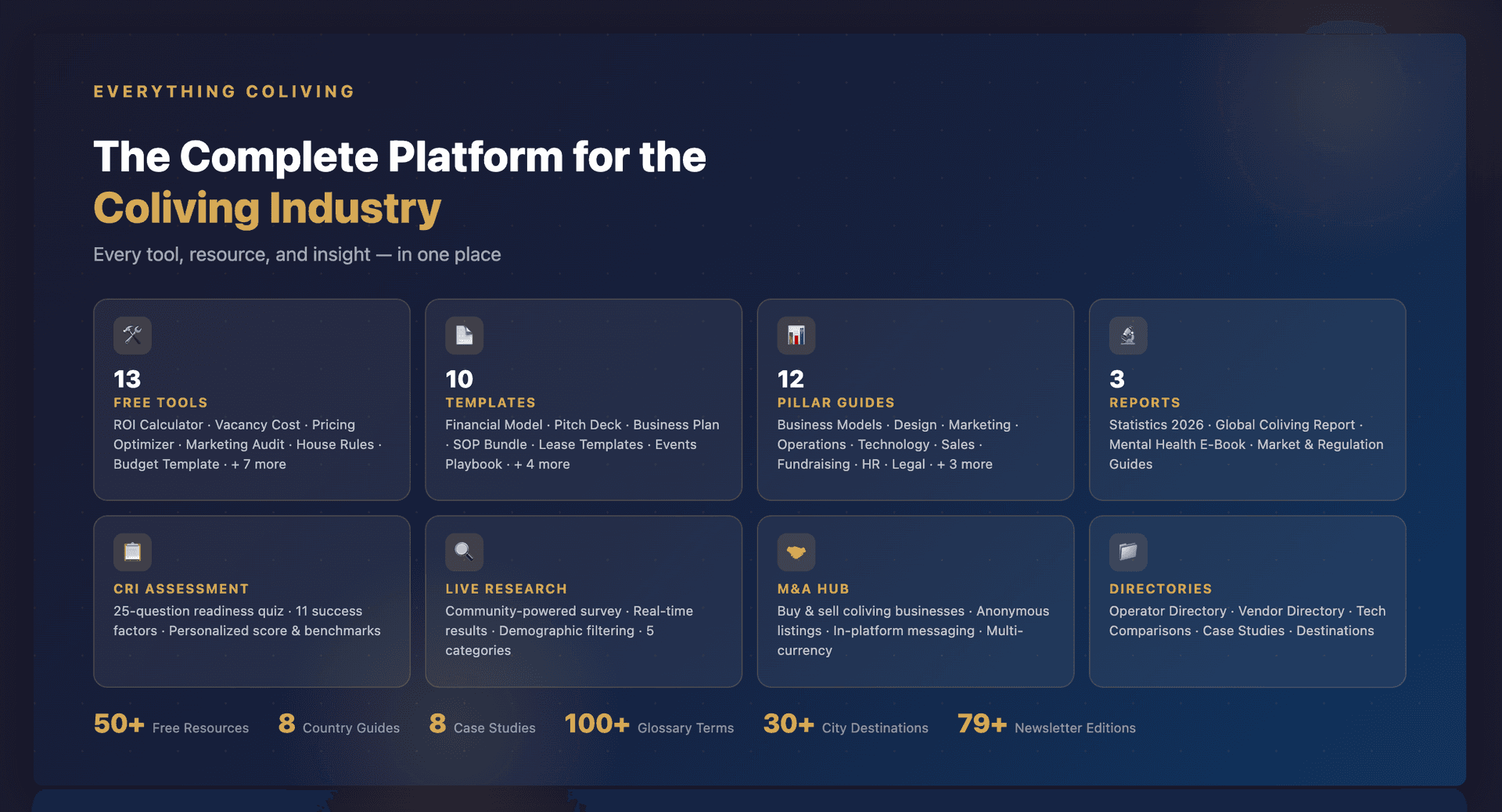
Everything We've Built for the Coliving Industry: The Complete Platform Guide
A comprehensive walkthrough of every free tool, template, report, directory, assessment, and resource on Everything Coliving, the world's most complete platform for coliving professionals.

How to Screen Tenants for Coliving: Background Checks & Best Practices
A complete guide to tenant screening for coliving operators, covering background checks, credit screening, reference checks, community fit assessment, and legal considerations.

How Coliving Businesses Are Valued
A comprehensive guide to coliving business valuation methods including income approach, EBITDA multiples, replacement cost, and worked examples for operators and investors.

Coliving Financial Model Walkthrough, Lisbon 20-Bed Example
A detailed financial model walkthrough for a 20-room coliving in Lisbon, including startup costs, monthly P&L, 3-year projections, sensitivity analysis, and key metrics.