

How to Calculate ROI on a Coliving Investment

Reviewed for accuracy
Mayank Pokharna, founder of Everything Coliving, reviewed this article. Basis of expertise: 13+ years operating and researching coliving; advisory work with 60+ operators across 14+ countries; primary source data from the EC operator dataset (500+ surveys). Financial and regulatory figures cross-referenced with JLL, CBRE, Cushman & Wakefield, and Knight Frank published research.
Why Coliving Investment Metrics Are Different
Coliving properties do not fit neatly into traditional real estate valuation models. The higher turnover, community-driven operations, and all-inclusive pricing create a unique financial profile that requires adapted analysis.
This guide walks you through the key metrics, with real numbers and formulas you can apply to your own investment analysis.
Key Financial Metrics
1. Revenue Per Available Bed (RevPAB)
The most important metric in coliving. RevPAB measures your actual revenue generation per bed, accounting for vacancy.
Formula: RevPAB = Total Room Revenue / (Total Beds x Days in Period) x 30
Example:
- 30-bed property
- Monthly room revenue: $27,000
- RevPAB = $27,000 / 30 = $900/bed/month
Industry Benchmarks:
- Budget coliving: $500-$800
- Mid-market: $800-$1,200
- Premium: $1,200-$2,000
- Luxury: $2,000+
2. Gross Operating Income (GOI)
Total revenue minus vacancy and concessions.
Formula: GOI = Gross Potential Rent - Vacancy Loss - Concessions + Ancillary Revenue
Example:
- Gross potential rent (30 beds x $1,000): $30,000/month
- Vacancy loss (13%): -$3,900
- Concessions (early bird discounts): -$600
- Ancillary revenue (laundry, events, parking): +$1,500
- GOI = $27,000/month = $324,000/year
3. Net Operating Income (NOI)
Your property's income after all operating expenses but before debt service and taxes.
Formula: NOI = GOI - Operating Expenses
Typical Operating Expense Breakdown for Coliving:
| Expense Category | % of GOI | Monthly ($) |
|---|---|---|
| Rent/Mortgage | 35-45% | $10,800 |
| Utilities | 8-12% | $2,700 |
| Cleaning | 5-8% | $1,620 |
| Staff (Community Manager) | 8-12% | $2,700 |
| Maintenance & Repairs | 3-5% | $1,080 |
| Insurance | 1-2% | $405 |
| Marketing | 3-5% | $1,080 |
| Technology (PMS, smart locks) | 1-2% | $405 |
| Furnishing Replacement Reserve | 2-3% | $675 |
| Admin & Professional Fees | 2-3% | $675 |
| Total Operating Expenses | 68-82% | $22,140 |
NOI = $27,000 - $22,140 = $4,860/month = $58,320/year
4. Cap Rate
The rate of return based on the property's NOI relative to its value.
Formula: Cap Rate = NOI / Property Value
Example:
- NOI: $58,320/year
- Property value: $900,000
- Cap Rate = $58,320 / $900,000 = 6.5%
Industry Benchmarks:
- Prime urban locations: 4.5-5.5%
- Secondary markets: 5.5-7.0%
- Emerging markets: 7.0-9.0%
5. Cash-on-Cash Return
Measures the annual return on your actual cash invested (accounting for leverage).
Formula: Cash-on-Cash = Annual Pre-Tax Cash Flow / Total Cash Invested
Example:
- Purchase price: $900,000
- Down payment (25%): $225,000
- Renovation: $150,000
- Furnishing: $75,000
- Working capital: $50,000
- Total cash invested: $500,000
- Annual NOI: $58,320
- Annual debt service: $38,400 (mortgage on $675,000 at 6%)
- Annual pre-tax cash flow: $19,920
- Cash-on-Cash = $19,920 / $500,000 = 3.98%
6. Internal Rate of Return (IRR)
The most comprehensive return metric, accounting for the time value of money across the entire hold period.
A typical 5-year coliving investment IRR model should account for:
- Initial investment (negative cash flow in Year 0)
- Annual cash flows (growing as occupancy stabilizes)
- Property appreciation (typically 3-5% annually for well-located coliving)
- Exit value (based on projected NOI and exit cap rate)
Target IRR Benchmarks:
- Conservative: 12-15%
- Moderate: 15-20%
- Aggressive: 20-25%
Building Your Financial Model
Revenue Assumptions
Model your revenue conservatively:
Year 1 (Lease-Up):
- Months 1-3: 40-60% occupancy
- Months 4-6: 60-80% occupancy
- Months 7-12: 80-90% occupancy
Year 2+:
- Stabilized occupancy: 85-92%
- Annual rent increases: 3-5%
- Ancillary revenue growth: 5-10%
Expense Assumptions
Be realistic about costs:
- Staff costs will increase 3-5% annually
- Utilities trend upward (budget 5% annual increase)
- Maintenance costs increase as the property ages
- Marketing can decrease as word-of-mouth builds (but never to zero)
- Furnishing replacement: Budget $500-$1,000 per bed per year
Sensitivity Analysis
Always model three scenarios:
| Scenario | Occupancy | RevPAB | NOI Margin |
|---|---|---|---|
| Bear Case | 75% | $800 | 15% |
| Base Case | 87% | $950 | 22% |
| Bull Case | 93% | $1,100 | 28% |
Common Financial Mistakes
- Underestimating lease-up time: Budget for 6 months to reach stabilized occupancy
- Ignoring seasonality: Some markets have significant seasonal demand variation
- Skipping the furnishing replacement reserve: Furniture in a shared home wears out faster than you think
- Over-leveraging: Conservative debt levels (60-70% LTV) protect against downturns
- Forgetting community manager costs: This role is essential and should not be cut to save money
- Not budgeting for technology: PMS, smart locks, and WiFi infrastructure are ongoing costs
Use Our Free Tools
Speed up your analysis with our free calculators:
- Coliving ROI Calculator - Model returns on any coliving investment
- Coliving Financial Model Template - Complete Excel model for coliving properties
- Operating Budget Template - Plan your annual operating expenses
Conclusion
Coliving can deliver attractive risk-adjusted returns when analyzed and managed properly. The keys are conservative underwriting, realistic expense projections, and a genuine commitment to the community experience that drives occupancy and retention.
The numbers work when the community works.
Free Newsletter
Join 37,000+ coliving professionals
Weekly insights on operations, marketing, and growth, delivered to your inbox.
ROI math for coliving: the five metrics LPs actually compare
"ROI" is a deceptively loose term in coliving conversations. EC investor interviews show that institutional LPs and sophisticated family offices rarely look at a single number; they compare five distinct return metrics, each capturing a different dimension of the deal. Operators that present only one (typically cash-on-cash or unlevered yield) get filtered out at first-pass diligence.
| Metric | What it captures | Healthy range (stabilised coliving) |
|---|---|---|
| Gross yield on cost | Revenue vs total project cost | 9-14% |
| Net yield on cost (NOI) | NOI vs total project cost | 5.5-8.5% |
| Cash-on-cash return | Cash flow after debt vs equity invested | 8-14% |
| Levered IRR (5-yr) | Time-weighted equity return incl. exit | 15-22% |
| Equity multiple (5-yr) | Total cash returned vs equity invested | 1.8-2.6x |
The full waterfall from revenue to investor return
Every coliving ROI calculation flows through the same waterfall. Get any line wrong and the downstream numbers are unreliable.
- Gross rental revenue: list price times occupancy times average tenure.
- Minus discount leakage: 1.5 to 3.5 percent of gross revenue.
- Equals net rental revenue.
- Plus ancillary revenue: F&B, parking, late check-out, premium amenities (typically 4 to 12 percent of net rent).
- Equals total operating revenue (TOR).
- Minus operating expenses: staff, utilities, food, cleaning, marketing, tech, insurance, property tax, repairs, management fee. Typically 38 to 52 percent of TOR.
- Equals NOI.
- Minus debt service: interest and amortisation.
- Equals cash flow before tax.
- Minus tax: jurisdiction-specific.
- Equals cash flow to equity.
Most novice operator models skip ancillary revenue, underweight discount leakage, and treat management fees as optional rather than mandatory. Each error inflates NOI by 200 to 600 bps versus reality.
The exit value: where most ROI calculations break
Levered IRR and equity multiple are dominated by the exit value at year 5 or 7. Two inputs drive the exit:
- Stabilised exit-year NOI: do not extrapolate aggressive ARPU growth into the exit year. EC investor interviews suggest LPs discount sponsor ARPU growth assumptions by 25 to 40 percent for exit valuation.
- Exit cap rate: 5.25 to 6.50 percent in Tier 1 EU/UK markets with a strong operator brand, 6.50 to 8.50 percent in emerging markets or with a weaker operating track record, 8.0 to 11.0 percent in India and similar emerging markets. Sponsors that pitch sub-5 percent cap rates outside top global capitals lose credibility instantly.
Cash-on-cash vs IRR: when each matters
Cash-on-cash is the right metric for an income-seeking investor (family office, individual sponsor, retiree). IRR is the right metric for institutional capital with a defined hold period and a return target tied to fund performance. A deal can have strong cash-on-cash (12 percent) but mediocre IRR (11 percent) if the exit cap rate softens; conversely, a deal with weak early cash-on-cash (6 percent) can produce a strong IRR (19 percent) if NOI grows and exit cap compresses.
The matching question to ask a prospective investor before pitching: "Do you optimise for cash yield or for total return?" The answer dictates which metric you lead with.
Common modelling errors that flatter the IRR
- Using a 100 percent occupancy assumption rather than the stabilised 88 to 93 percent.
- Modelling ARPU growth at 5 to 7 percent annually rather than CPI plus 100 bps.
- Excluding pre-opening expenses, FF&E replacement reserves (typically 3 to 5 percent of revenue), and management fees.
- Assuming a flat exit cap rate equal to the entry cap rate, rather than modelling 50 to 100 bps of softening.
- Treating interest-only debt as if it generates equity return through amortisation it does not deliver.
- Counting capex and FF&E as a separate line item, then forgetting to add it back into total project cost when calculating yield.
- Excluding selling costs at exit (typically 2.5 to 4.5 percent of sale value).
Sensitivity analysis: the three views every model should include
- Base case: sponsor's best-estimate assumptions. Targeted IRR 15 to 22 percent.
- Downside: occupancy at 80 percent, ARPU haircut 8 percent, opex inflation 12 percent, exit cap softens 100 bps. Targeted IRR 6 to 10 percent (still positive).
- Upside: occupancy 95 percent, ARPU growth 6 percent annually, opex inflation 2 percent, exit cap compresses 50 bps. Targeted IRR 25 to 32 percent.
The base case is what you pitch. The downside is what institutional LPs underwrite against. The upside is the carrot, but is never the basis for committing capital. Sponsors that fail to present all three views are routinely rejected at IC stage regardless of how attractive the base case appears.
Benchmarking against alternative real-estate yields
| Asset class | Net yield range | Levered IRR range |
|---|---|---|
| Multifamily (US Class A) | 4.5-5.5% | 10-14% |
| PBSA (UK/EU) | 4.5-5.5% | 11-15% |
| BTR (UK) | 4.0-5.0% | 10-14% |
| Mature coliving (Tier 1) | 5.5-7.0% | 14-19% |
| Emerging coliving (Tier 2) | 7.0-10.0% | 16-24% |
| HMO (UK) | 5.5-8.0% | 14-19% |
Coliving's positioning in the institutional return ladder sits above multifamily and PBSA on yield but below specialist hospitality on operating complexity. Investors who understand this trade explicitly are the ones most likely to write a cheque.
Written by
Mayank Pokharna
Mayank Pokharna is the founder of Everything Coliving. 13+ years in coliving as an operator, PMS builder (JumboTiger, SimplyGuest), and advisor to 60+ operators advised across 14+ countries. Listed as a coliving expert on co-liv.org, featured in Forbes India, BBC Punjabi, Financial Express, and Economic Times, and published on the economics of shared living.
Explore Related Topics
Free Tools
Further Reading
Related Articles
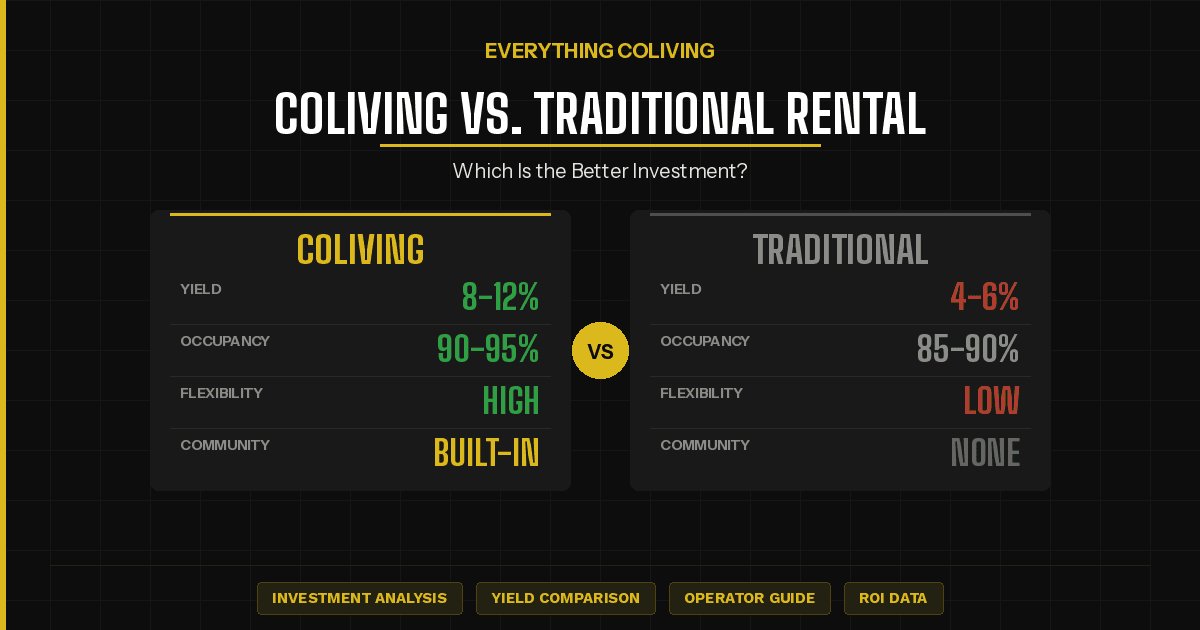
Coliving vs. Traditional Rental: Which Is the Better Investment?
Compare the financial returns, risks, and operational demands of coliving investments against traditional buy-to-let properties.

Revenue Per Available Bed (RevPAB): The Key Metric for Coliving Operators
Learn how to calculate, benchmark, and improve Revenue Per Available Bed (RevPAB), the essential performance metric for coliving operators.

Coliving Pricing Models: How to Price Rooms, Beds & Packages
A complete guide to coliving pricing strategies including all-inclusive vs tiered models, per-bed vs per-room pricing, dynamic pricing, and ancillary revenue.

Coliving Insurance: What Coverage Do You Actually Need?
Navigating insurance for coliving properties is complex. This guide covers the essential policies, common gaps, cost benchmarks, and how to avoid expensive mistakes.

Coliving Staff Compensation Benchmarks by Region
Regional salary benchmarks for every coliving role including community managers, operations managers, cleaning staff, and maintenance, with compensation structures and benefits.