How to Build a Coliving Brand That Attracts the Right Residents

Reviewed for accuracy
Mayank Pokharna, founder of Everything Coliving, reviewed this article. Basis of expertise: 13+ years operating and researching coliving; advisory work with 60+ operators across 14+ countries; primary source data from the EC operator dataset (500+ surveys). Financial and regulatory figures cross-referenced with JLL, CBRE, Cushman & Wakefield, and Knight Frank published research.
How to Build a Coliving Brand That Attracts the Right Residents
In a market with growing competition, your brand is what separates you from every other coliving space with a nice kitchen and fast WiFi. A strong brand does not just attract more residents. It attracts the right residents, the ones who stay longer, contribute to the community, and refer their friends.
Define Your Brand Identity
Start with Your "Why"
Why does your coliving space exist beyond making money? The most compelling coliving brands have a clear purpose:
- Enabling remote workers to live and work anywhere
- Creating intergenerational communities that combat isolation
- Building sustainable urban living solutions
- Fostering creative communities for artists and entrepreneurs
Your "why" should be authentic and specific. "We bring people together" is too generic. "We create homes where entrepreneurs build the future together" is specific and compelling.
Identify Your Ideal Resident
Create a detailed resident persona:
- Demographics: Age, income, profession, location
- Psychographics: Values, lifestyle preferences, goals
- Pain points: What problems does coliving solve for them?
- Decision drivers: What matters most in choosing where to live?
Everything from your website copy to your common area design should speak to this persona.
Craft Your Visual Identity
Logo and Color Palette
Your visual identity should reflect your brand personality. A coliving space for young professionals might use bold, modern colors. A wellness-focused community might lean toward earth tones and organic shapes.
Photography Style
Invest in professional photography that shows real community moments, not staged stock photos. Capture:
- Genuine interactions between residents
- Well-lit common areas in use (not empty)
- The neighborhood and surrounding area
- Details that make your space unique
Consistent Design System
Create templates for social media, email newsletters, and print materials that maintain visual consistency. This builds recognition and trust.
Build Your Digital Presence
Website
Your website is your storefront. It should:
- Load quickly and work flawlessly on mobile
- Clearly communicate your value proposition in the hero section
- Include virtual tours or video walkthroughs
- Feature resident testimonials and community stories
- Make it easy to book a tour or apply
Social Media
Choose 2-3 platforms where your ideal residents spend time. For most coliving operators:
- Instagram for visual storytelling and community highlights
- LinkedIn for professional networking and thought leadership
- TikTok for reaching younger demographics with authentic content
Post consistently and engage with your community. Share behind-the-scenes content, resident spotlights, and local area guides.
Content Marketing
Create valuable content that your ideal residents search for:
- City guides for digital nomads
- "Day in the life" videos from residents
- Blog posts about community living benefits
- Local event roundups
The Brand Experience
Your brand extends far beyond marketing. Every touchpoint shapes perception:
- First inquiry response: Speed and warmth matter
- Move-in experience: Make it memorable with a welcome kit
- Community events: Reflect your brand values
- Maintenance responses: Show you care about details
- Move-out process: Leave a positive lasting impression
Measuring Brand Strength
Track these indicators:
- Referral rate: What percentage of new residents come through referrals?
- Social media engagement: Not followers, but engagement rate
- Review scores: Google, Facebook, and coliving listing platforms
- Time to fill vacancies: Stronger brands fill faster
- Resident retention: Do residents stay and renew?
Common Branding Mistakes
- Being generic: "Modern coliving in [city]" says nothing
- Overpromising: Do not promise "family" if your community is transient
- Inconsistency: Different messaging across channels confuses prospects
- Ignoring negative reviews: Address them professionally and promptly
- Copying competitors: Find your own voice and own it
Your brand is a promise to your residents. Make it authentic, deliver on it consistently, and it becomes your most valuable asset.
Free Newsletter
Join 37,000+ coliving professionals
Weekly insights on operations, marketing, and growth, delivered to your inbox.
Brand archetypes that actually work in coliving
Coliving brand strategy clusters around four working archetypes. Most successful operators commit to one and refuse the others. Operators trying to straddle multiple archetypes confuse prospects and underperform on retention.
The Productivity-Forward archetype
Outsite, Selina (post-pivot), Roam. Built around "you're here to work; we'll handle everything else." Visual identity: clean minimalism, soft-tech aesthetic, gold + neutral tones. Messaging: efficiency, focus, no-friction setup. Programming: optional, opt-in, professional networking. Target tenant: 28-45 year old senior individual contributors and consultants. ARPU premium: 15-25% over baseline.
The Community-Forward archetype
Cohabs, Mason & Fifth, Common (early). Built around "the people are the product." Visual identity: warm photography of real residents, hand-drawn elements, earth tones. Messaging: belonging, shared meals, conversations. Programming: high-touch, weekly anchor events, designed for organic friendship formation. Target tenant: 22-32, often early-career or in transition. ALOS premium: 30-50% over baseline.
The Affordability-Forward archetype
PadSplit, Tripalink. Built around "the math is the value prop." Visual identity: clean, functional, not aspirational. Messaging: explicit per-month savings vs alternatives. Programming: minimal. Target tenant: workforce, students, early-career. Volume premium: 2-3x bed count per property.
The Place-Forward archetype
Mojo Nomad (Asia), Outpost (Bali), Sun and Co (Spain). Built around "you're choosing this place; we're the access vehicle." Visual identity: location-driven, lifestyle photography, neighborhood-specific. Messaging: the city/region is the hero, the coliving is the enabler. Programming: location-immersion. Target tenant: international, 25-40, on geographic discovery. RevPAB premium: 20-40% over baseline.
Audience segmentation that drives conversion
Generic operator marketing fails because the target prospect is actually 4-6 distinct sub-segments with different needs. The most operationally useful segmentation we've seen:
- The Just-Arrived Nomad (1-3 month stays, high social needs, price-sensitive within international range). Found via Nomad List, Instagram, Reddit. Converts on community photos + visa/banking practicality content.
- The Mid-Career Transition (4-9 month stays, professional networking value, mid-priced). Found via LinkedIn + content marketing. Converts on professional community evidence + flexible-lease terms.
- The Corporate Assignee (3-12 month stays, expense-account level, low community needs). Found via corporate relocation partnerships. Converts on operational reliability + invoicing infrastructure.
- The Long-Term Resident (9+ month stays, residential expectations, premium pricing tolerance). Found via referrals + neighborhood marketing. Converts on quietness + storage + privacy.
- The Local Young Professional (varies, value-driven, language-specific). Found via local social media + university partnerships. Converts on affordability comparison + neighborhood quality.
Operators that explicitly design landing pages, programming, and pricing tiers for each of these segments materially outperform operators with a single "for everyone" funnel.
Pricing as positioning
The most under-discussed brand decision is pricing relative to comparable alternatives. Coliving operators systematically underprice premium positioning and overprice value positioning, both of which damage the brand.
The pricing-positioning matrix: (1) Premium positioning at 1.4-1.8x equivalent studio rent works only if the property and operations actually deliver. Premium pricing without premium product reads as a scam; tenants leave at month 2-3. (2) Mid-market positioning at 1.0-1.3x equivalent studio rent is the largest segment; most operators sit here. (3) Value positioning below equivalent studio rent works only for genuine workforce / student-adjacent products. Mid-market operators pricing here destroy margin and signal "not as good as we look."
The single most expensive branding mistake we see: premium visuals + mid-market pricing. The prospect sees the photos, expects the premium experience, finds mid-market reality, churns at month 2-3, and writes a 2-star review citing the gap between marketing and reality. Better to underdress your brand and overdeliver than the opposite.
Brand consistency at the operational layer
Brand isn't an asset that sits in marketing. It's a thousand small decisions across the operating layer. The ones that show up in NPS surveys and review data:
- Response time on inquiries. Under 2 hours = premium brand signal. Over 24 hours = mid-market or worse, regardless of marketing aesthetic.
- Move-in coordination. Pre-arrival email with practical neighborhood info, day-of welcome with snacks/water + 30-min orientation, day-3 check-in. Every premium brand does these; most operators don't.
- Cleaning standards. The single highest-correlation factor in NPS surveys. Common areas cleaned daily, not 3x/week, separates premium from mid-market.
- Maintenance SLA. 24-hour response, 72-hour resolution for non-emergency. Premium operators have this written in the lease and meet it.
- Move-out handling. Deposit returned in under 14 days, written ledger explanation if any deduction. Half of negative reviews mention move-out friction.
If your operations can't deliver consistently on these, your brand will not survive in reviews regardless of visual identity quality.
Content marketing that compounds
Most coliving operator content marketing fails to compound because it's not localized enough. Generic blog posts about "remote work tips" can't compete with established lifestyle media. The category where coliving operators reliably win on SEO + organic discovery: hyper-local content with operator-specific perspective.
Examples that work: "Top 5 cafes for remote work in San Felipe (Bogotá)" written by a community manager who actually works in San Felipe. "Visa renewal in Berlin from inside Germany" written by an operator who's handled 40 tenant visa applications. "Cost of living in Lisbon, what I pay monthly as a coliving operator" written transparently with real numbers.
Content that doesn't work: generic city guides duplicating Nomad List, recycled "future of work" trend pieces, brand-narcissist content about company history. None of it ranks; none of it converts.
Measuring brand strength operationally
Brand is measurable. The five metrics worth tracking quarterly:
- Inbound-vs-outbound mix. Healthy brands receive >35% of leads inbound (direct, organic search, referral). Operators below 20% are pure performance-marketing; brand isn't yet pulling.
- Referral rate. Best-in-class coliving operators see 25-40% of new residents from existing-resident referrals. Below 10% is a brand-fit problem, not a marketing problem.
- Branded search volume. Track "[your brand] coliving" search queries monthly. Growing >10% MoM is brand health; flat or declining is a warning.
- Review sentiment + volume. Volume of recent reviews > 8 per quarter signals an active community. Sentiment > 4.5 average is premium-tier.
- Time-on-site + bounce rate. Brand pull shows up as engaged sessions, not just traffic. Time-on-site > 3 min and bounce rate < 45% signal strong narrative pull.
When to rebrand
Rebrand triggers worth taking seriously: (a) major shift in target tenant segment (e.g., from nomad to corporate); (b) M&A integration where the acquirer's brand will dominate; (c) genuine product transformation where the new offer needs new naming. NOT good rebrand triggers: a marketing-team change, declining inbound that's actually a positioning problem, founder boredom with the existing visuals.
Rebrand costs are typically underestimated. A meaningful coliving rebrand involves: visual identity ($15-40k), website + app refresh ($30-80k), property signage refresh ($800-2,000 per property), legal name changes if applicable, channel-listing updates across 8-20 platforms, lost organic search traffic from URL changes (6-12 months recovery). Total: $100-250k for a 10-property operator. Don't rebrand because you're bored. Rebrand because the existing brand is actively impeding strategic outcomes.
Written by
Mayank Pokharna
Mayank Pokharna is the founder of Everything Coliving. 13+ years in coliving as an operator, PMS builder (JumboTiger, SimplyGuest), and advisor to 60+ operators advised across 14+ countries. Listed as a coliving expert on co-liv.org, featured in Forbes India, BBC Punjabi, Financial Express, and Economic Times, and published on the economics of shared living.
Explore Related Topics
Further Reading
Related Articles

Coliving Team Structure at Every Stage
A practical guide to building your coliving team from solo operator to multi-property scale, with org charts, hiring triggers, and outsource vs hire decisions.

Google Business Profile Optimization for Coliving Operators
A step-by-step guide to setting up and optimizing your Google Business Profile for coliving, including review strategies and performance tracking.

How to Screen Tenants for Coliving: Background Checks & Best Practices
A complete guide to tenant screening for coliving operators, covering background checks, credit screening, reference checks, community fit assessment, and legal considerations.

HMO Licensing for Coliving in the UK: Complete 2026 Guide
Everything coliving operators need to know about HMO licensing in the UK: mandatory vs additional licensing, application process, costs, penalties, and recent 2026 changes.
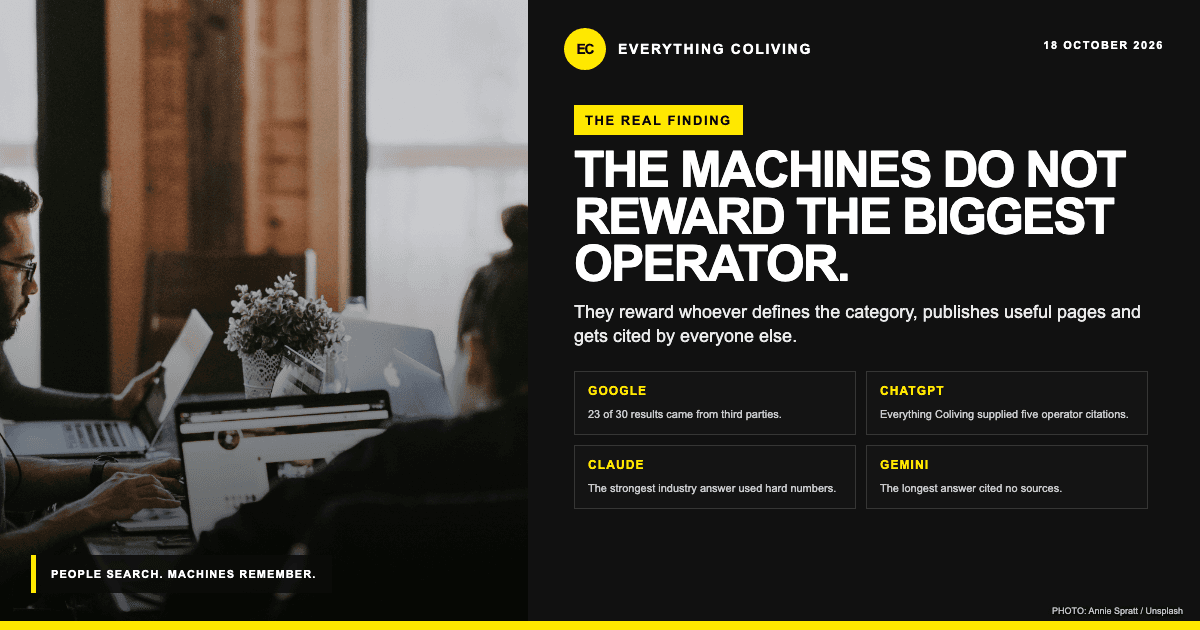
I Googled 'best coliving companies in the world'. Then I asked the AIs (Claude, Chatgpt, & Gemini)
I typed “best coliving companies in the world” into Google, ChatGPT, Claude and Gemini. 38 names came back. Only two showed up on all four, and neither is the biggest operator. Here’s what each platform rewards and how coliving operators can use it to get ranked and cited.