

Coliving vs Co-Living: The Definitive Guide to Spelling, Branding & SEO

The Great Spelling Debate: Coliving or Co-Living?
If you have spent more than five minutes researching shared living, you have almost certainly encountered both "coliving" and "co-living" used interchangeably across websites, press articles, and industry reports. The inconsistency is not just a stylistic quirk, it has real implications for branding, search engine optimization, and how the industry presents itself to the wider world.
This guide is the definitive resource on the spelling question. We trace the history of both forms, analyze how search engines treat them, look at what the major operators and media outlets use, and give you a clear, evidence-based recommendation for your own brand and content strategy.
A Brief History of the Term
From Cooperative Housing to Coliving
The concept of shared, intentional living is centuries old. From medieval guild halls to 19th-century utopian communities, humans have always experimented with communal arrangements. The modern term, however, emerged in the early 2010s as a distinct label for a new wave of professionally operated shared housing aimed at young professionals and digital nomads.
Early pioneers in the space, companies like Common, WeLive, and Roam, initially used the hyphenated form "co-living," drawing a parallel with the well-established "co-working." The prefix "co-" (meaning together or jointly) was already familiar from cohousing, cooperation, and coexistence, and the hyphen seemed grammatically logical.
The Shift to a Single Word
By 2017-2018, a visible shift had begun. Industry conferences, research firms, and several major operators started dropping the hyphen. The reasoning was both practical and strategic:
- Brand identity: "Coliving" as one word feels more like a distinct concept rather than a modification of "living." It signals that this is a category, not merely a description.
- URL and domain clarity: Domains like coliving.com are cleaner than co-living.com, and hashtags like #coliving work better on social platforms.
- Industry maturation: As the sector professionalized, stakeholders wanted a single, unified term, much like "email" evolved from "e-mail."
Today, "coliving" (one word, no hyphen) is the dominant form in industry usage, while "co-living" retains significant presence in mainstream media and academic writing.
How Google Treats Both Spellings
Search Volume Analysis
Google Trends and keyword research tools reveal that both spellings command significant search volume, but "coliving" has overtaken "co-living" in most English-speaking markets since approximately 2020. Here is the approximate split as of early 2026:
- "coliving": ~60-65% of total search volume for the combined term
- "co-living": ~35-40% of total search volume
In some non-English markets, the hyphenated form remains slightly more popular, particularly in German-speaking countries where compound words are handled differently.
Does Google Consider Them the Same Query?
This is the critical question for SEO. Google's algorithms are sophisticated enough to recognize that "coliving" and "co-living" refer to the same concept. In most cases, the same pages rank for both variants. However, there are subtle differences:
- Exact match still matters slightly: A page optimized for "coliving spaces in Berlin" may rank marginally better for that exact query than a page using "co-living spaces in Berlin," and vice versa.
- Featured snippets can differ: Google occasionally serves different featured snippets for each spelling variant.
- Google autocomplete treats them separately: Typing "coliving" and "co-living" produces different autocomplete suggestions, indicating Google tracks them as distinct but related queries.
SEO Recommendation
The data-driven approach is clear: use "coliving" as your primary term, but naturally include "co-living" in your content as well. This ensures you capture search traffic from both variants without keyword stuffing. A practical approach is to use "coliving" in your page titles, H1 headings, URLs, and meta descriptions, while using "co-living" occasionally in body copy, especially in the introduction or in a parenthetical note like "coliving (also written co-living)."
What the Major Operators Use
One Word: Coliving
The majority of established operators now use the single-word form:
- Common: Uses "coliving" across their website and marketing materials
- Habyt: Consistently uses "coliving"
- Vonder: Uses "coliving" in primary marketing
- Outsite: Uses "coliving" and "coliving spaces"
- Sun and Co: Uses "coliving" (and pioneered the term "coliving retreat")
Hyphenated: Co-Living
Some operators and media still prefer the hyphenated version:
- The Collective: Has used both but leans toward "co-living" in formal communications
- BBC and mainstream media: Generally use "co-living" as it follows standard English hyphenation rules
- Academic researchers: Tend to use "co-living" in published papers
Industry Bodies
The European Coliving Alliance and most industry conferences use "coliving" (one word), which has effectively established it as the industry standard.
Branding Implications for Your Coliving Business
Consistency is King
Whichever spelling you choose, the most important rule is absolute consistency. Mixing "coliving" and "co-living" on your own website looks unprofessional and confuses search engines about your primary keyword. Audit your entire web presence, website, social media bios, Google Business Profile, OTA listings, email signatures, and standardize.
Domain Name Considerations
If you are building a brand around the coliving concept, consider how your domain reads. Domains with "coliving" as one word tend to be cleaner:
- yournamecoliving.com reads better than yournameco-living.com
- Subdomains and paths are simpler: /coliving-spaces vs /co-living-spaces
Social Media Hashtags
Hashtags cannot contain hyphens, which makes #coliving the universal social media form. This alone is a strong argument for using the unhyphenated version across all channels for consistency. On Instagram, #coliving has over 500,000 posts, while searching "co-living" simply returns #coliving results.
Free Newsletter
Join 37,000+ coliving professionals
Weekly insights on operations, marketing, and growth, delivered to your inbox.
Other Spelling Variations to Be Aware Of
Beyond the hyphen debate, you may encounter other forms:
- CoLiving (camel case): Sometimes used in brand names or titles but generally not recommended for body text. It looks like a tech product name rather than a housing category.
- Co Living (two words, no hyphen): Grammatically awkward and rarely used intentionally. If this appears on your site, it is likely a typo.
- co-living (lowercase with hyphen): Acceptable in running text where you would not capitalize a common noun.
- Coliving (capitalized): Use when starting a sentence or in titles; otherwise, lowercase "coliving" in body text.
Regional Differences
United States
The US market has largely standardized on "coliving," driven by the Silicon Valley tendency to create single-word category names (fintech, proptech, edtech). Most US-based operators and investors use the unhyphenated form.
United Kingdom
The UK market is more split. Mainstream media and government documents tend to use "co-living" (the BBC, The Guardian, and local councils generally hyphenate). However, UK operators themselves increasingly use "coliving." If you are applying for HMO licensing, be aware that council documents almost always say "co-living."
Europe (Non-English)
In German, the term "Coliving" (capitalized, as all German nouns are) is standard. In Spanish, both "coliving" and "co-living" appear, but the unhyphenated form is gaining ground. French publications tend toward the hyphenated "co-living" but this is not settled.
Asia-Pacific
Markets like India, Singapore, and Australia generally follow the "coliving" (one word) convention, influenced by the global industry trend.
The Email vs E-mail Parallel
The closest analogy to the coliving spelling evolution is "email" vs "e-mail." In the early days of the internet, "e-mail" was the standard form, the Associated Press Stylebook did not officially switch to "email" until 2011. Today, "e-mail" looks dated and is rarely used.
Coliving is on the same trajectory. The hyphenated form is not wrong, but it is increasingly seen as the older, more formal variant. Within the next few years, "coliving" will almost certainly become the universally accepted form, just as "email" did.
Practical Recommendations for Operators
Use "coliving" (one word, no hyphen) as your primary term. Include "co-living" naturally in your content to capture both search variants. Be absolutely consistent across all your channels and materials.
Your SEO Checklist
- Primary keyword: Use "coliving" in your page titles, H1 tags, meta descriptions, and URLs
- Secondary keyword: Include "co-living" once or twice in body content, preferably in the introduction
- Alt text: Use "coliving" in image alt text for primary images
- Internal linking: Use "coliving" as your standard anchor text (see our what is coliving guide for an example)
- Schema markup: Use "coliving" in your structured data descriptions
- Google Business Profile: Use "coliving" in your business description
Your Branding Checklist
- Choose one spelling and document it in your brand style guide
- Audit all existing content for inconsistencies
- Update social media bios, email templates, and marketing collateral
- Brief any PR agencies or freelance writers on your preferred spelling
- Check that your OTA listings (Airbnb, Booking.com, NomadX) use consistent spelling
Conclusion
The coliving vs co-living debate is not just pedantic, it touches on SEO strategy, brand identity, and how an entire industry presents itself. The evidence points clearly toward "coliving" as the standard going forward, and we recommend adopting it as your primary term. But do not ignore "co-living" entirely, include it naturally in your content to ensure you capture traffic from both search variants. For a deeper dive into the coliving concept itself, explore our comprehensive guide to what coliving is and how it compares to traditional apartments.
Written by
Mayank Pokharna
Mayank Pokharna is the founder of Everything Coliving. 13+ years in coliving as an operator, PMS builder (JumboTiger, SimplyGuest), and advisor to 60+ operators advised across 14+ countries. Listed as a coliving expert on co-liv.org, featured in Forbes India, BBC Punjabi, Financial Express, and Economic Times, and published on the economics of shared living.
Explore Related Topics
Further Reading
Related Articles

Best Coliving Consultants and Experts Worldwide (2026)
Would you like to create a coliving space or improve it?

What Is Coliving? The Definitive Guide for 2026
Everything you need to know about coliving in 2026. What it is, how it works, who it's for, what it costs, and why it's becoming the housing model of the future.
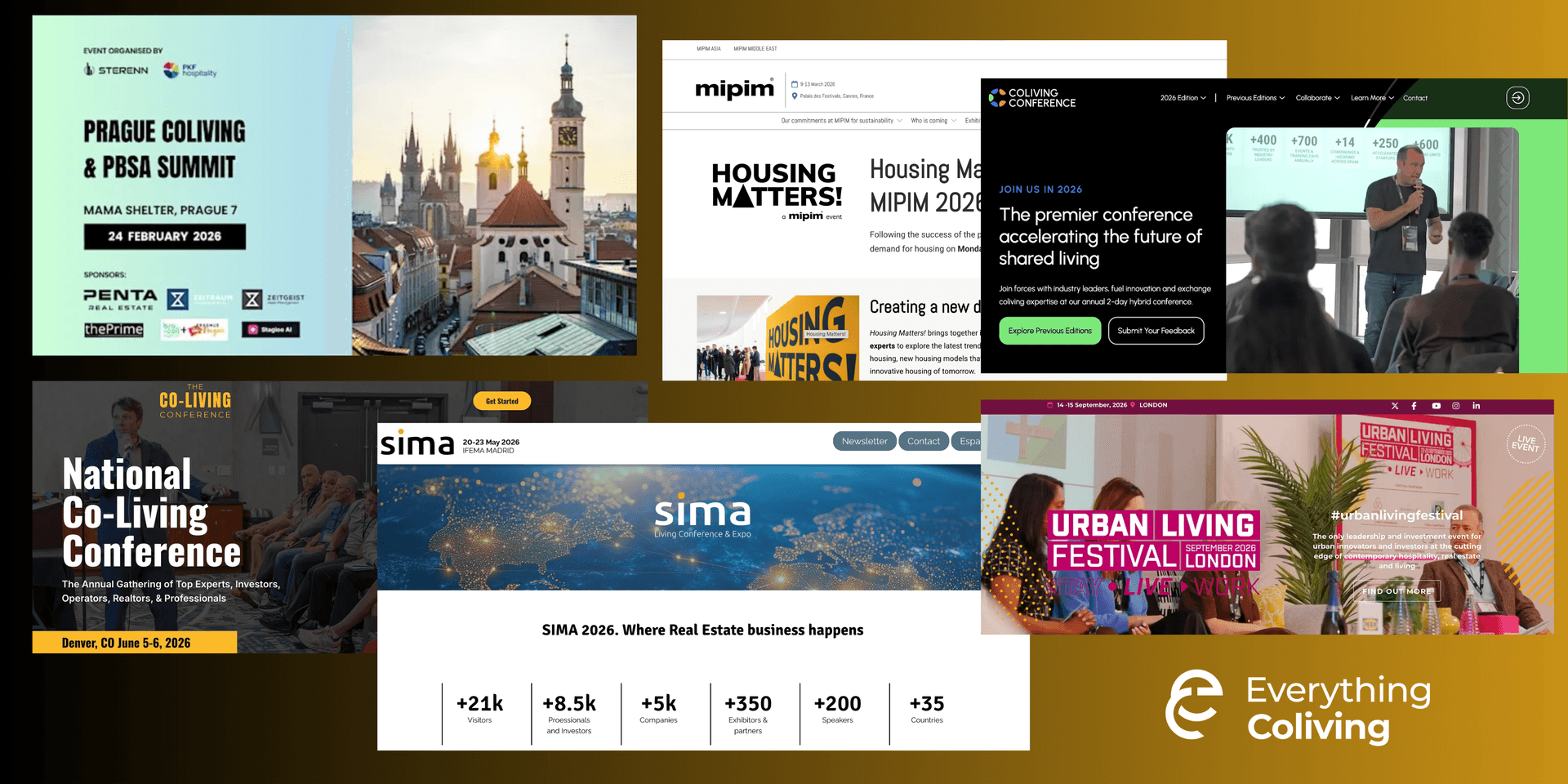
Coliving Conferences and Events in 2026
If you want to understand where coliving is heading in 2026, don’t just watch the headlines, watch the rooms where the conversations are happening.

Coliving vs Co-Housing vs Shared Housing: What Is the Difference?
Confused by the terminology? We break down the key differences between coliving, co-housing, and traditional shared housing - from business models to community structures.
Coliving Consulting 101: Why You Need Experts for Your Coliving Project
The global coliving sector is booming, offering affordable, community-driven living solutions in cities worldwide. In fact, the global co-living market is...