

CasaPay Launched an MCP Server for Rent, and It Changes Everything
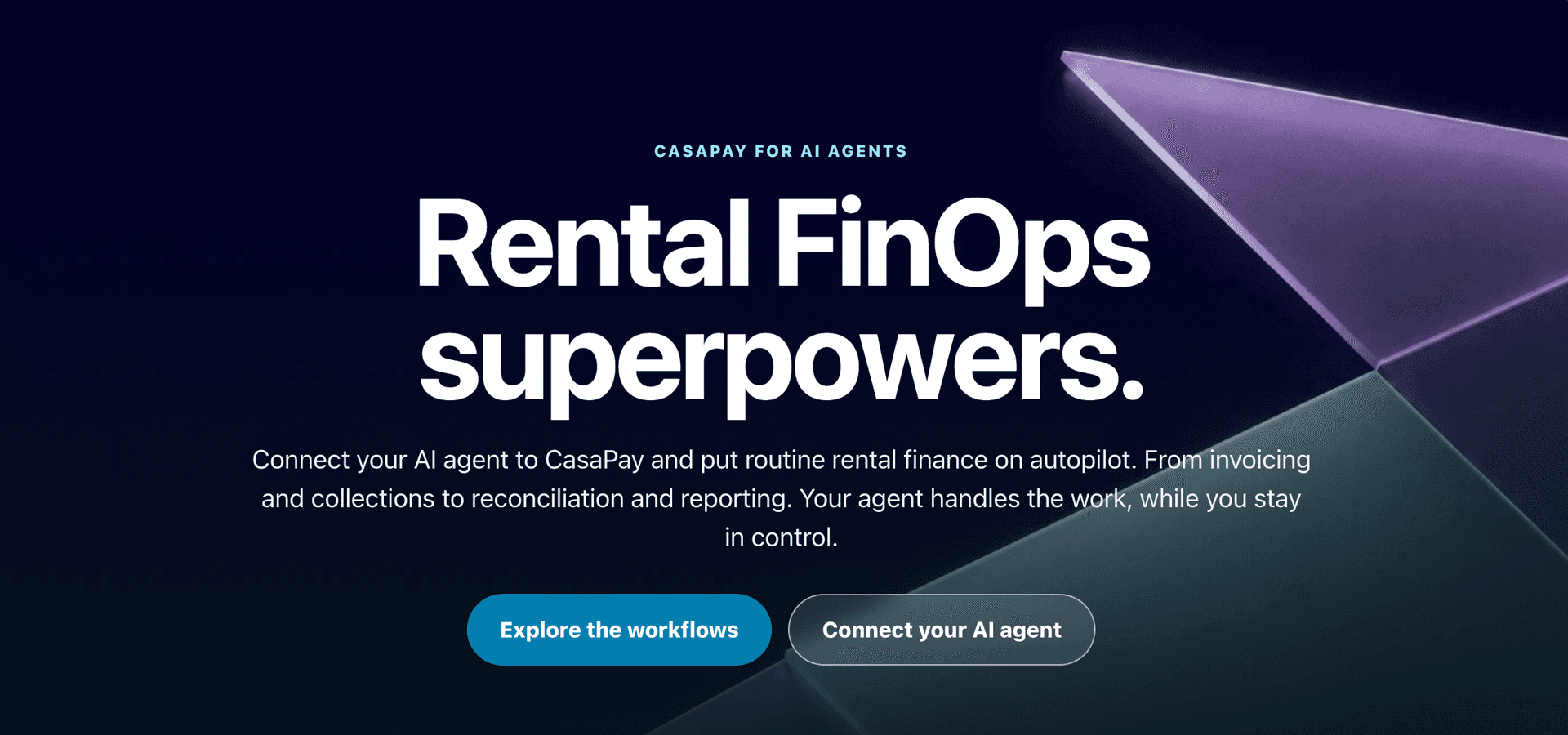
Rent just became something an AI agent can do, not just something a person clicks through. CasaPay, the rent-collection and assurance platform we recommend to coliving operators, has published a Model Context Protocol (MCP) server for rent. It exposes core rent operations as tools that any MCP-connected agent, whether that is Claude, ChatGPT, Cursor or an operator's own in-house agent, can call directly. It reads like a small, technical release. It is not. It is one of the clearest signals yet of where the whole rental industry is heading.
Here is why we think it changes everything, and what coliving operators should do about it.
First, what an MCP server actually is
MCP, the Model Context Protocol, is a shared standard for letting AI agents use real tools and data instead of only talking about them. Think of it as a universal adapter between an assistant and the software that runs your business. Once a system publishes an MCP server, an agent can use it much as a developer would call an API, but in plain language and as one step inside a larger task.
Until now, "AI for rent" mostly meant a chatbot bolted onto a dashboard. An MCP server is different in kind. It turns the underlying operations, collect this rent, offer this deposit choice, chase this arrears, into verbs an agent can execute under permission, rather than screens a human has to navigate.
Why rent is the perfect thing to make agent-callable
Rent is the largest recurring household expense, and until now it has been almost completely agent-unready. There has been no standard way for an assistant to understand a lease, verify a tenant, hold a deposit, take the first month, or reconcile it back to the operator's books. CasaPay's MCP server is a direct attempt to fix that, and rent turns out to be unusually well suited to the approach for three reasons.
- It is repetitive and rule-bound. Collections, reminders, reconciliation and arrears follow the same steps every month, which is exactly the kind of work agents do well.
- It has a hard layer underneath. Money movement, verified identity, regulated obligations and recovery cannot be faked by a chatbot; they need real rails. That hard layer is what an MCP server for rent exposes.
- The workflow is commoditising, but the money is not. As agents take over the clicking, value moves down to the layer they have to call. Rent has one, and it is deep.
One MCP for the whole rent job, not just a payment link
The part that matters most is what sits behind the single interface. This is not only one-time and recurring payment links. Through one MCP, an AI agent, and equally a human operator, can reach the entire rent job: payment links, tenant verification and KYC, deposit management, a payment guarantee, and reporting and analytics. One connection, the whole rental money workflow, designed for rental operators and their agents rather than assembled from parts.
Today an operator stitches that together from separate vendors: a payment processor here, a KYC provider there, a deposit scheme, a rent guarantor or insurer, and a reporting tool on top, each with its own login, contract and integration. Collapsing all of it into a single agent-callable surface is the point. The agent does not have to learn five systems; it calls one.
What it changes for operators
For a coliving operator, the practical shift is that the rent workflow becomes a set of instructions your own agent can carry out while you supervise, instead of tasks you click through yourself. A few of the patterns this unlocks:
- Agent-run collections. An in-house system can ask its agent to create the month's rent checkouts, watch which ones clear, and escalate the ones that do not. One manager plus an agent does the work of a small back office.
- Verification, deposits and guarantee in the same call. Because tenant KYC, deposit handling and the payment guarantee live behind the same MCP as collection, an agent can verify a tenant, set the deposit option and put a guarantee in place as part of one flow, instead of bouncing between a KYC vendor, a deposit scheme and an insurer.
- Embedded money for AI-native platforms. A property system can call rent operations per tenant, agreement, deposit choice and first payment, without having to become a payments company itself.
- An arrears and recovery copilot. Listing unpaid invoices, issuing structured follow-ups and setting up repayment plans becomes cheap enough to run on every small arrears, supervised by a human manager.
- Reporting and analytics on demand. Reporting comes through the same interface, so an operator who wants a specific breakdown does not wait on a data team; the agent pulls it from the MCP. When one operator asked for a particular report, the answer was simply to point their agent at the MCP.
- Accounting and audit agents. A finance agent with scoped, read-only access can reconcile into your ledger and pull month-end together in hours rather than days.
Crucially, this is built to be safe. Scoped credentials per agent, spend limits and approval thresholds on anything sensitive, a full audit trail, and a sandbox to test in. The goal is not to hand an agent free rein over regulated steps; it is to remove the manual chasing that eats a community manager's week.
Free Newsletter
Join 37,000+ coliving professionals
Weekly insights on operations, marketing, and growth, delivered to your inbox.
What it changes for tenants
The tenant side is just as significant. Discovery is moving from scrolling listings to asking an assistant. In that world the winning primitives are verified inventory, a portable tenant identity, and a checkout an agent can actually complete. The answer taking shape is an agent-friendly checkout that operators embed on their own websites, paired with a consented, portable tenant profile, identity, affordability evidence, rent-payment history and deposit status, that a tenant's agent can carry from one home to the next.
For operators, that points to a label worth earning: "AI agents welcome." An operator whose own site runs an agent-operable checkout becomes bookable by the assistants tenants are starting to rely on, while the booking and payment still happen on the operator's own website. Early movers here are, quite literally, close to the only inventory an agent can find today.
The bigger picture: the PMS market is splitting into three
Step back and the MCP launch fits a larger restructuring. The property-management software market is pulling apart into three groups: legacy per-seat suites that are struggling as AI erodes the seat value they charge for; operators building their own flexible systems with AI-assisted coding; and a fast-growing, well-funded wave of fully agentic platforms where agents, not screens, run operations.
What all three share is that none of them wants to rebuild rent money movement, and all of them need it. A neutral rent rail with an MCP interface can sit under every one of them the same way. That is why an MCP server is a strategic move and not just a feature: whichever software architecture wins, the rent layer underneath can stay constant.
Why this is hard to copy, from either direction
The obvious question is whether a horizontal player like Stripe simply adds it. Structurally they will not, because rent is a vertically deep problem and horizontal rails deliberately stay on the simple side of it. Rent money is client money: client-money duties, safeguarding and segregated accounts, statutory deposit-protection schemes, and jurisdiction-by-jurisdiction compliance all sit with whoever handles the rent. A checkout processor treats a payment as a moment; rent is a recurring obligation wrapped in identity, regulation, risk and recovery.
The point-solution vendors cannot easily copy it either. A payment processor, a KYC provider, a deposit scheme, a rent guarantor and an insurer each own one slice of the rent job. None of them owns the whole vertical, and none exposes it as a single agent-callable interface. That combination is the moat: one vertical MCP that handles payments, verification, deposits, guarantee and reporting for rental operators and their agents, where everyone else offers only a fragment. The defensibility is the vertical depth, going deep on rent rather than wide across every payment, which is exactly what a horizontal rail or a single-purpose vendor will not do.
What coliving operators should actually do
You do not need to rebuild anything tomorrow. But the direction is now clear enough to prepare for.
- Get your rent stack agent-ready. Favour tools with structured, machine-readable operations and clean reconciliation over closed dashboards. If you are choosing a rent platform, our rent collection and payments comparison lays out the options.
- Put a real checkout on your own website. Owning the booking and payment flow on your own site, rather than only on a portal, is what makes you discoverable to tenants' agents later.
- Start building portable tenant history. Every rent payment collected cleanly today compounds into the verified history agents will use to shortlist tomorrow.
- Learn how the pieces fit. The technology pillar and the free Coliving Academy cover how the software stack and the money layer work together.
Where this goes next
It is still early. The tooling is new and will keep maturing. But the trajectory is not subtle. Over the next year, expect agentic rent to move from demo to daily practice, with "first prompt to first live payment" measured in minutes, and the "AI agents welcome" badge starting to appear on operator sites. Over a few years, for students, relocators and mobile professionals, the assistant becomes the primary way people find and book a home, with a portable rent reputation as the credential that carries the application.
Adoption curves compress when the user is an agent: there is no new app to learn and no habit to build, because the assistant is already on hundreds of millions of phones. The capability was never really the blocker. The missing piece was the rails, a verified way in, a consented identity, an agent-operable checkout, and money movement with guardrails. An MCP server for rent is one of the first credible attempts to lay them, and that is why a quiet technical release is worth paying close attention to.
Frequently asked questions
What is an MCP server for rent?
It is a standardised interface that lets AI agents call real rent operations, such as creating a rent checkout, offering a deposit option or chasing arrears, as tools under scoped permissions and an audit trail, rather than a person clicking through a dashboard.
Does this mean an AI agent controls my rent money?
No. The design keeps humans in control of regulated and monetary steps through scoped credentials, spend limits, approval thresholds and a full audit trail. Agents remove the manual, repetitive work; they do not get free rein over client money.
What should a coliving operator do about it now?
Favour rent tools with structured, machine-readable operations, own a real checkout on your own website, and start building clean, portable tenant payment history. Those three moves make you agent-ready without a rebuild.
Is this just a payment link with an AI wrapper?
No. Payment links, one-time and recurring, are one part of it. The same MCP also covers tenant verification and KYC, deposit management, a payment guarantee, and reporting and analytics, all through one agent-callable interface built for rental operators. That vertical breadth, rather than a single payment action, is the point.
Is this the same as listing on a portal?
No. The approach keeps booking and payment on the operator's own website and makes that flow operable by a tenant's agent, so you keep the customer relationship instead of handing it to a portal.
Everything Coliving helps operators get their technology and rent stack ready for the agent era. Explore technology for operators, talk to a coliving consultant, or see how coliving advisory works. CasaPay is our specialist pick for rent collection and a contributor to our rent research.
Written by
Mayank Pokharna
Mayank Pokharna is the founder of Everything Coliving. 13+ years in coliving as an operator, PMS builder (JumboTiger, SimplyGuest), and advisor to 60+ operators advised across 14+ countries. Listed as a coliving expert on co-liv.org, featured in Forbes India, BBC Punjabi, Financial Express, and Economic Times, and published on the economics of shared living.
Explore Related Topics
Further Reading
Related Articles

The Future of Coliving: 10 Trends Shaping the Industry Through 2030
Where is coliving headed? From AI-powered operations to intergenerational communities, explore the trends that will define the next era of shared living.

Mental Health in Coliving: Building Communities That Support Wellness
Coliving can be powerful for mental health or harmful if poorly managed. Learn how operators can design spaces and programs that support resident wellness.

Canada's Office Vacancy Problem Is Coliving's Biggest Opportunity
Key Takeaways: - Canada's coliving market is at Day 1 and that's a massive opportunity for first-movers - Office-to-coliving conversion can deliver units in 9 months at lower cost than new builds - The 'room → street → neighbourhood' design philosophy is a best-practice framework for community at scale - Pre-leasing with anchor employers is a smart de-risking strategy for investors - Affordability, loneliness, and climate are three problems co-living addresses simultaneously and that's a powerful policy and investor narrative

AI & Automation in Coliving: Smart Operations for Modern Operators
Explore how AI and automation are transforming coliving operations, from chatbots and dynamic pricing to predictive maintenance and smart energy management.
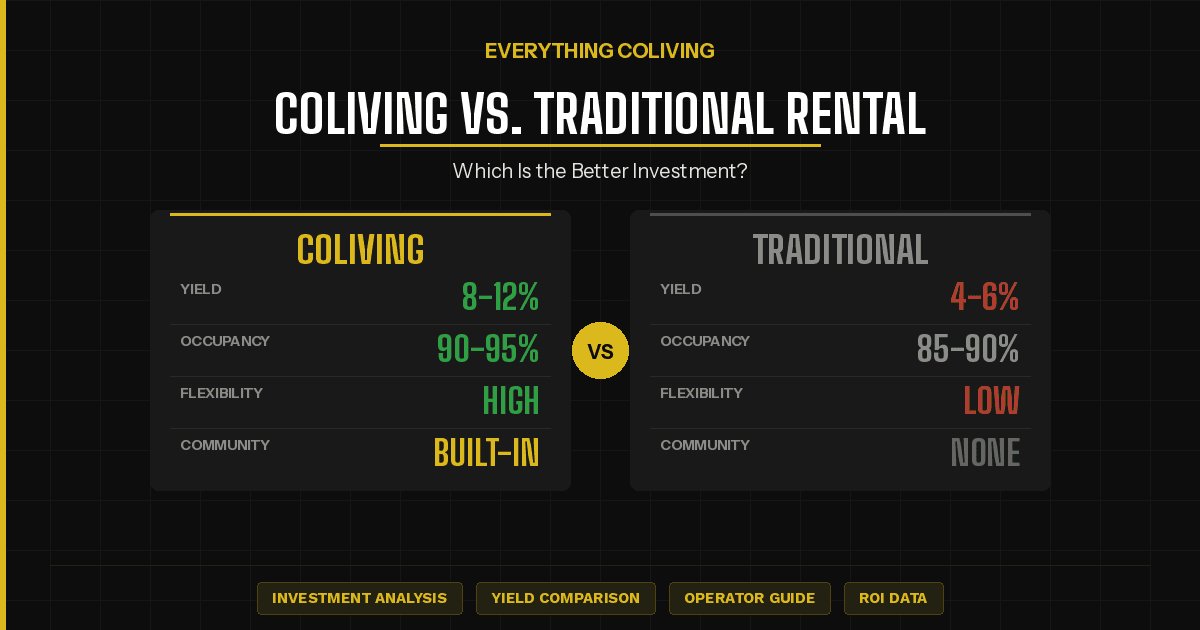
Coliving vs. Traditional Rental: Which Is the Better Investment?
Compare the financial returns, risks, and operational demands of coliving investments against traditional buy-to-let properties.