

Types of Coliving Business Models Investors Should Know
Reviewed for accuracy
Mayank Pokharna, founder of Everything Coliving, reviewed this article. Basis of expertise: 13+ years operating and researching coliving; advisory work with 60+ operators across 14+ countries; primary source data from the EC operator dataset (500+ surveys). Financial and regulatory figures cross-referenced with JLL, CBRE, Cushman & Wakefield, and Knight Frank published research.
(The following content is written by Mayank Pokharna. You can reach out to him in case you want to chat more about all things coliving)
If you came to this article directly, consider going through the series of articles it is a part of. Please find the link to the other articles in the Coliving fundraising and investment series here:
- The Rise of Coliving Investments
- What Makes Coliving a Profitable Investment?
- Types of Coliving Business Models Investors Should Know
- Securing Capital: Fundraising Strategies for Coliving Businesses
- Key Factors to Consider Before Investing in Coliving Space
- How Legal and Regulatory Aspects Can Impact Coliving Investment
- Case Studies: Successful Coliving Ventures and What Investors Can Learn
- Opportunities and Risks: Is Coliving a Safe Investment?
- How to Get Started with Coliving Investment Today
- Why Coliving Investment is the Future of Real Estate
- Ready to Invest? Start Your Coliving Journey with Us
Investors venturing into the coliving space need to understand the different
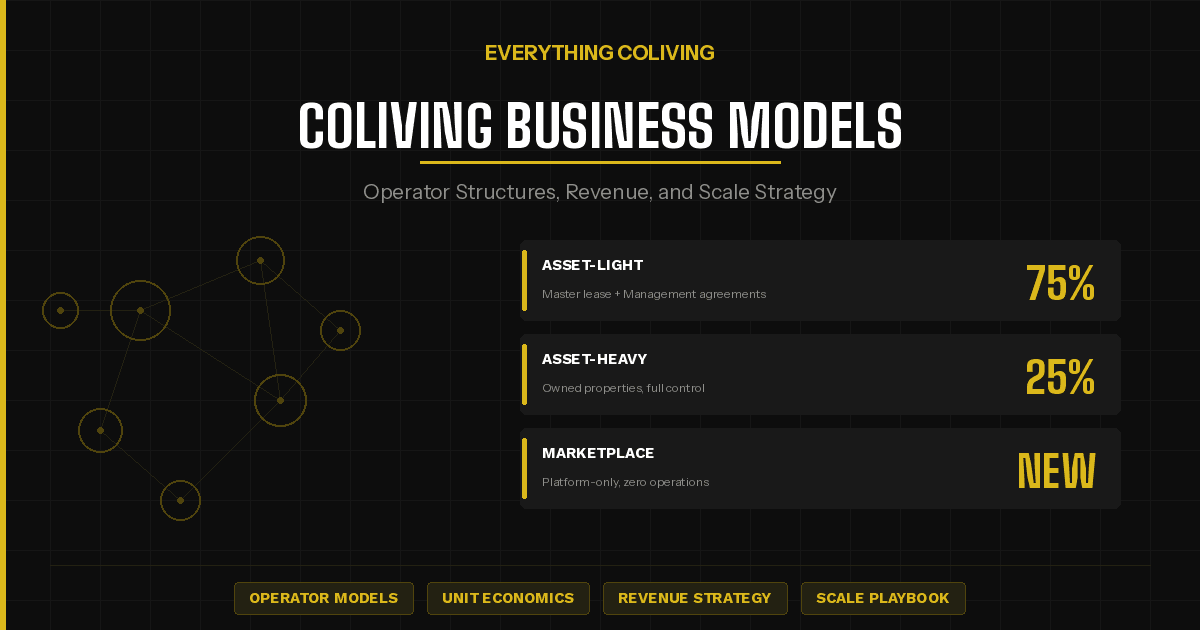
business models available. Each model offers unique advantages and challenges, and selecting the right one depends on factors like capital availability, risk tolerance, operational expertise, and long-term goals. Broadly, coliving businesses can adopt asset-heavy, asset-light, or hybrid models , each with distinct strategies for scaling and profitability.
Asset-Heavy Model: Ownership-Based Approach
- What it is: In this model, the coliving operator owns the property . They handle everything from acquisition and development to operations and maintenance.
- Advantages:
- Greater control over the property : Operators have complete freedom to design, renovate, and manage the space according to brand standards.
- Long-term capital appreciation : Investors benefit from real estate value appreciatio n over time.
- Increased profit margins : Since operators don’t pay rent to landlords, the revenue generated directly contributes to the bottom line.
- Challenges:
- High initial capital requiremen t: Buying property demands significant upfront investment.
- Higher risk exposur e: Operators bear the entire financial risk in case of vacancies or market downturns.
- Limited scalabilit y: Acquiring properties is capital-intensive, which may slow down expansion.
- Best fo r: Investors with high capital reserv es and a focus on long-term appreciati on and brand contr ol.
- Example: Some operators, like Node, The Collective in its early days, adopted asset-heavy models by acquiring and developing large coliving properties in urban centers.
Asset-Light Model: Lease-and-Operate Approach
- What it is: In an asset-light model, the coliving operator leases properties from landlords and focuses on management, tenant services, and community building. This model reduces the need for upfront capital while allowing for faster scaling .
- Advantages:
- Lower capital requirements : Operators don’t need to buy properties, which makes it easier to expand into multiple locations.
- Flexible growth : Leases allow operators to quickly enter and exit market s based on performance.
- Operational focus : Without the burden of property ownership, operators can concentrate on tenant experience and community buildin g.
- Challenges:
- Lower profit margin s: Operators need to pay rent, which limits profitability.
- Dependence on landlord s: Operators must negotiate favorable lease terms to maintain profitability, and rental increases can impact margins.
- Lease risk s: Long-term leases can become a liability during market downturns or periods of low occupancy.
- Best fo r: Investors and operators seeking rapid scalabili ty with lower upfront investme nt.
- Example:Habyt and VerveLife are known for leveraging the asset-light model, allowing them to expand into multiple cities by partnering with landlords.
Hybrid Model: Mixed Ownership and Lease Strategy
- What it is: The hybrid model combines elements of both asset-heavy and asset-light strategies , where the operator owns some properties and leases others . This model provides operational flexibility while also securing the benefits of property ownership.
- Advantages:
- Balanced risk : Operators can own core properties for long-term stability while leasing other spaces to test new market s.
- Optimized returns : Hybrid models enable operators to diversify income source s by balancing rental payments with asset appreciation.
- Scalable and sustainable growth : This model offers the ability to scale quickl y while maintaining key strategic assets.
- Challenges:
- Complex managemen t: Operators must manage both leased and owned properti es, which can increase operational complexity.
- Moderate capital requirement s: Operators still need access to significant capital for property acquisition.
- Best fo r: Established operators looking to expand sustainab ly while managing both ownership and rental portfolios.
- Example:The Social Hub (formerly The Student Hotel) uses a hybrid model, owning key properties in high-demand areas while leasing other spaces to quickly expand across Europe.
Mixed-Use Developments: Coliving Plus Coworking and Retail Spaces
- What it is: Some coliving operators integrate coworking spaces, retail units, or other amenities into their developments, creating neighborhood hubs that foster community and attract diverse tenant groups.
- Advantages:
- Diverse revenue streams : Operators can generate income from retail rentals, coworking memberships, and event hostin g.
- Attractive to tenants : Residents benefit from access to workspaces, shops, and amenities within the same development, enhancing tenant retention.
- Improved community engagement : Mixed-use developments foster interaction between residents, local businesses, and the broader communit y.
- Challenges:
- High operational complexit y: Managing multiple revenue streams and operations can require significant expertise.
- Longer planning and approval processe s: Mixed-use developments may face more regulatory hurdl es and longer timelines for approval.
- Best fo r: Investors and operators with experience in complex projec ts looking to create high-value community hu bs.
- Example:Colonies in France integrate coworking spaces and local partnerships into its coliving properties, adding value for both residents and the surrounding community.
Franchise Model: Expanding Through Brand Licensing
- What it is: In a franchise model, an operator licenses its brand and operational framework to franchisees who manage individual coliving properties. This model allows rapid expansion without direct ownership or operational responsibility for every unit.
- Advantages:
- Rapid scalability : Franchise models enable operators to grow their brand without large capital investment s.
- Shared responsibility : Franchisees handle day-to-day operation s, while the parent company focuses on branding and strategic growt h.
- Franchise fees : The operator earns revenue through franchise fees, royalties, and brand partnership s.
- Challenges:
- Maintaining quality contro l: Ensuring consistent service across multiple franchisees can be challenging.
- Brand ris k: Poor performance by franchisees can negatively affect the brand’s reputation.
- Best fo r: Established coliving brands looking to expand global ly while minimizing capital expenditure.
- Example: While less common in coliving today, some operators are exploring franchising models to scale operations in new markets with minimal risk.
Selecting the Right Business Model for Your Coliving Investment
Choosing the right business model is crucial for maximizing profitability and managing risk . Whether you opt for an asset-heavy model that focuses on long-term capital gains, an asset-light model for rapid scalability, or a hybrid model for balanced growth, your decision should align with your investment strategy and market conditions .
For investors seeking diversificati on, mixed-use developmen ts offer additional revenue streams, while franchise mode ls provide opportunities to expand a brand with lower ri sk. Understanding the nuances of each business model will allow investors to make informed decisio ns and build sustainable, profitable coliving ventures.
Written by
Mayank Pokharna
Mayank Pokharna is the founder of Everything Coliving. 13+ years in coliving as an operator, PMS builder (JumboTiger, SimplyGuest), and advisor to 60+ operators advised across 14+ countries. Listed as a coliving expert on co-liv.org, featured in Forbes India, BBC Punjabi, Financial Express, and Economic Times, and published on the economics of shared living.
Explore Related Topics
Free Tools
Further Reading
Related Articles

How to Reduce Operating Costs in Your Coliving Space
Actionable strategies for coliving operators to reduce operating costs by 15-30% across utilities, cleaning, technology, furnishing, and staffing.

How to Calculate ROI on a Coliving Investment
A practical guide to calculating returns on coliving investments. Covers cap rates, cash-on-cash returns, IRR, and the key financial metrics every coliving investor needs.
Coliving Feasibility Study: How to Analyze Your Project Before You Invest
A step-by-step guide to conducting a coliving feasibility study. Learn the financial analysis, market assessment, and site evaluation frameworks used by successful operators.

Coliving Financial Model Walkthrough, Lisbon 20-Bed Example
A detailed financial model walkthrough for a 20-room coliving in Lisbon, including startup costs, monthly P&L, 3-year projections, sensitivity analysis, and key metrics.

Coliving vs HMO Investment: Which is Better? (UK Focus)
A detailed comparison of coliving and HMO investments in the UK market, covering returns, regulations, operational requirements, and which model suits different investor profiles.