

Top Coliving Spaces in Lima

Lima is fast becoming one of South America’s top digital nomad hubs. With its world-class culinary scene (central to the global gastronomic boom), affordable cost of living, and Pacific ocean views, the Peruvian capital attracts remote workers who want city life without the price tag of Europe or North America. However, navigating the rental market here can be chaotic. Traditional leases often require complex guarantor paperwork ("aval") and long-term commitments that don't suit the nomadic lifestyle.
Looking to actually book a stay?
This is an editorial guide, Everything Coliving is a content + advisory platform for operators, not a booking engine. To actually find availability and pricing for Lima:
- Browse our Top Coliving Spaces directory + Operators Directory
- Check the major booking aggregators: BookMyColiving.com, Coliving.com, Spotahome, HousingAnywhere, Outsite
If you're an operator and want your space listed in our directory, submit it here.
Quick facts (editorial averages)
- Typical stay length: 1-12 months (most operators want 1mo+ minimum)
- Per-day / short stay: Rare, most Lima operators don't run nightly rates. Check Outsite or hostels for <30-day stays.
- Pet policy: Mixed, typically allowed with deposit + restrictions; ask each operator directly.
- Rent range: Varies by neighborhood, see the operator-level pricing below or our city benchmarks for the Lima stabilised RevPAB band.
Editorial averages from our operator network. Individual Lima operators set their own policies, always confirm directly before booking.
Coliving is the solution. Operators in Lima - concentrated heavily in the safe, walkable districts of Miraflores and Barranco - offer plug-and-play living. You get high-speed internet (crucial in a city where public Wi-Fi can be spotty), workspace, and an instant community of travelers.
While rent in Lima is generally lower than in Dublin or London, the "Coliving Premium" here buys you security (24/7 concierges are standard), English-speaking support, and freedom from utility bills. The list below covers the top operators and platforms you need to know.
For a quick overview of the best options, here is the full list at a glance:
Top Lima Coliving Companies (Quick Reference)
Colive World: A specialized directory and platform helping nomads filter and find coliving spaces across the city.
Colive World
Colive World functions as a specialized discovery platform/directory for the coliving market. For Lima, it aggregates various independent operators and shared living spaces that might not have the marketing budget of a major chain. It is a useful tool for comparing different "tribes" - whether you are looking for a surfer house in nearby Punta Hermosa or a tech-focused house in the city center.
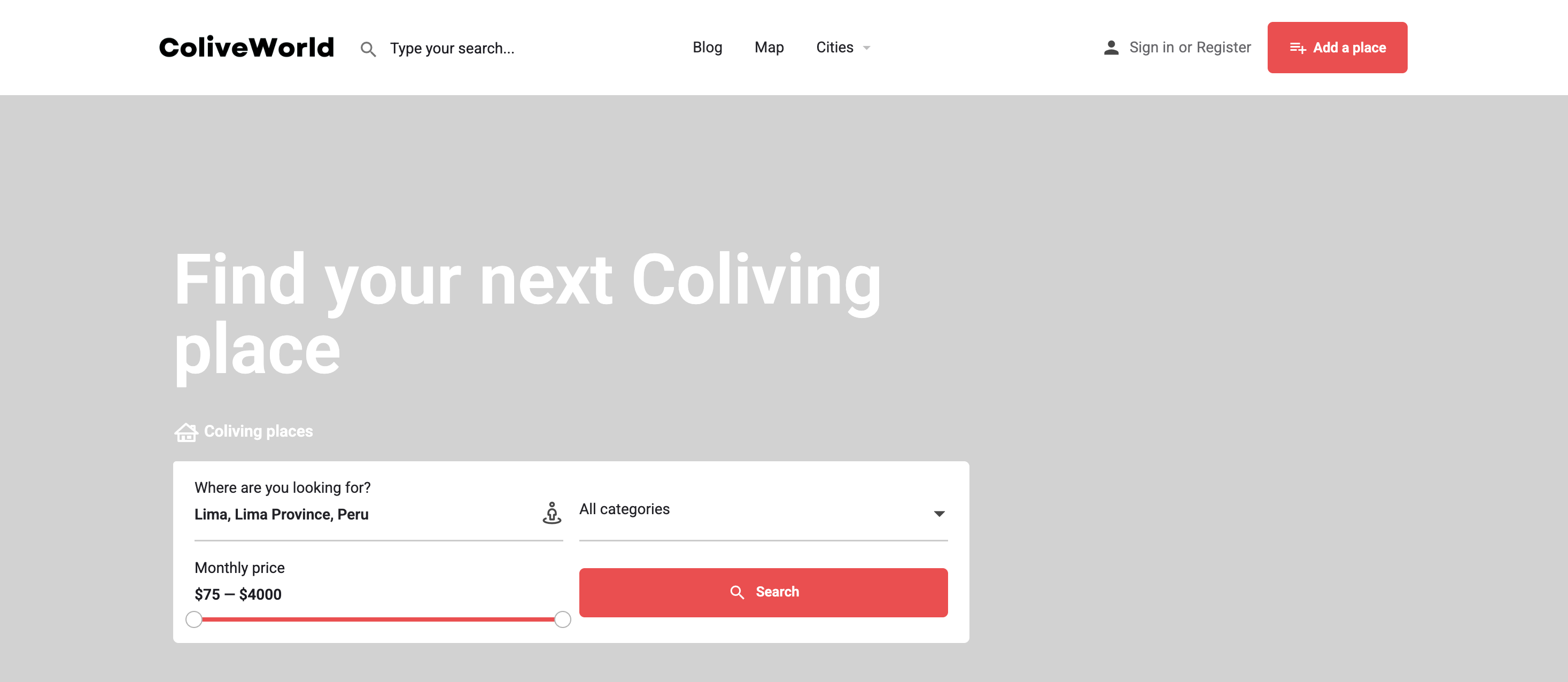
Location: Lima-wide. Covers various neighborhoods, allowing you to filter by proximity to surf spots or coworking hubs.
Website: https://coliveworld.com
Pricing: Transparent comparison. Shows monthly rates clearly, helping you spot value options in the $400 - $800 range.
Deposit: Dependent on the specific operator found through the platform.
Rental Terms: Flexible. The platform specializes in flexible living, so most listings cater to the 1-month+ nomad demographic.
Amenities: Filters allow you to search specifically for "Coworking," "Gym," or "Private Bathroom," helping you find the exact amenities you need.
Insider Tip: Lima's winter (May to October) is constantly grey and humid (known as "La Garúa"). If you book during these months, ensure your coliving space has a comfortable, well-lit workspace, as you might spend more time indoors than you think. In summer (December to April), a space near the Malecón in Miraflores is essential for sunset walks.
Want to get your coliving space listed? Contact us to be featured in this guide.
Why Lima is an emerging coliving market
Lima is one of the more under-served LatAm coliving markets in 2026. Demand drivers: digital nomad inflow into Miraflores and Barranco, growing tech ecosystem (Crehana, Krealo), Latin American intra-region migration, and remote-worker visa programmes. Operating economics favor entry: rents 30-50% below Mexico City, abundant building stock, permissive regulatory environment.
The current coliving landscape
Operator-led inventory in Lima is still measured in hundreds of beds, not thousands. The market is largely informal Airbnb-converted-to-coliving + small boutique operators. The few dedicated coliving brands operate primarily in Miraflores, Barranco, and emerging in Surco and San Isidro.
Notable existing properties
- 1900 Hostel + Coliving - boutique, Barranco-adjacent
- Multiple Outsite-affiliated properties - smaller scale, digital-nomad targeted
- Local boutique operators in Barranco - typically 8-20 bed converted houses
Operating economics
- RevPAB: $300-$700 per bed/month depending on neighborhood + amenity tier
- ALOS: 2-5 months blended - heavy nomad share keeps ALOS short
- Occupancy ceiling: 85-92% in Miraflores/Barranco
- Operating margins: 35-45% NOI - lower labor + utilities than Mexico City; partial USD pricing
- Cap rates: 9-12% (emerging market premium)
Why operators are entering Lima
- FX advantage - PEN exchange rate stability + USD pricing capability
- Cost arbitrage migration from Bogotá, BA, Mexico City
- Established digital-nomad infrastructure in Miraflores/Barranco
- Lower acquisition cost than mature LatAm markets
- Permissive regulation - no equivalent of Berlin Zweckentfremdung or NYC LL18
Risks specific to Lima
- Political instability - 2022-2023 cycles affected tourism + nomad inflow
- Smaller institutional capital pool
- Limited brand operators - most growth is via boutique single-property operators
- Earthquake risk - building structural compliance important
Free Newsletter
Join 37,000+ coliving professionals
Weekly insights on operations, marketing, and growth, delivered to your inbox.
Related resources
Lima neighborhood-level pricing operators actually quote
Lima's coliving market is small but growing, anchored in Miraflores and Barranco with secondary supply emerging in San Isidro and Surco. The table below summarises 2026 quoted rents from EC operator dataset across the six neighborhoods most coliving operators concentrate in.
| Neighborhood | Private room (shared bath) | Private room (ensuite) | Studio unit | Typical tenant profile |
|---|---|---|---|---|
| Miraflores | PEN 1,800-2,600 | PEN 2,500-3,800 | PEN 3,200-5,200 | Digital nomads, expats, business travellers |
| Barranco | PEN 1,600-2,400 | PEN 2,300-3,500 | PEN 3,000-4,800 | Creative nomads, longer-stay artists, remote workers |
| San Isidro | PEN 1,900-2,800 | PEN 2,700-4,200 | PEN 3,500-5,800 | Finance, corporate professionals, embassy staff |
| Surco / Chacarilla | PEN 1,400-2,000 | PEN 2,000-3,000 | PEN 2,800-4,000 | Returning Peruvians, mid-career professionals |
| San Borja | PEN 1,300-1,900 | PEN 1,900-2,800 | PEN 2,600-3,800 | Local professionals, students at nearby universities |
| La Molina | PEN 1,200-1,800 | PEN 1,800-2,600 | PEN 2,400-3,400 | Families, longer-stay residents, suburban preference |
USD-denominated quotes are common in Miraflores and San Isidro for nomad-focused operators, typically running USD 480-1,100/month all-in for ensuite product.
Operator economics in Lima
EC operator interviews suggest Lima coliving operators in 2026 typically run:
- Stabilized occupancy: 78-88%, with material seasonality between November-March (high) and June-August (lower).
- Gross margin: 30-38% for well-run operators with 25+ beds. Below that scale, fixed-cost drag compresses margin into the low-20s.
- Average length of stay: 3.8-5.6 months. Nomad-focused product runs shorter; corporate-focused product runs longer.
- OpEx per bed/month: PEN 480-780 depending on neighborhood and amenity stack.
What foreign operators consistently get wrong about Lima
- Underestimating seasonality. Lima's coastal microclimate and the South American academic calendar combine to produce a real winter trough. Underwrite to 78% blended occupancy, not the peak-month 92%.
- Misreading the Miraflores premium. The premium exists, but it is narrower than tourist operators assume. Barranco runs at 90-95% of Miraflores ADR with materially better fit-out economics on heritage stock.
- Skipping the Junta de Propietarios. Building HOAs in Lima have real veto power over coliving conversions. Several foreign operators have been forced to unwind deals after acquiring units in buildings whose Junta did not approve commercial-style use.
- Mispricing the dollar. Operators who quote in PEN and pay debt in USD have absorbed 8-14% FX drag during 2023-25. Currency hedging is mandatory at any meaningful scale.
Visa, residency, and the demand pipeline
Peru's tourist visa allows 183 days per year for most Western passport holders, which is the structural ceiling for the digital nomad cohort. The 2024 introduction of a longer-stay remote worker visa pathway (still administratively friction-heavy) and the established Carne de Extranjeria pathway for longer-term residency together support a deeper foreign-resident demand pool than most operators realise.
The Lima-Cusco-Arequipa corridor is the natural travel pattern for nomads; coliving operators in Lima with informal partnerships in Cusco and Arequipa report 12-18% better LTV through cross-property stay continuity.
Transit, airport, and the practical geography
Jorge Chavez International Airport's 2025 expansion has reduced friction for inbound flights but Lima ground transport remains the friction point. Operators in Miraflores and Barranco benefit from proximity to the Costa Verde and Linea 1 metro extensions scheduled for completion in 2027-28. Operators in Surco and La Molina depend more heavily on private transport, which materially affects perceived quality of life and length of stay.
The next 18 months in Lima
- Continued nomad supply expansion. Expect 2-3 new operator entries in Miraflores and Barranco through 2027, with at least one regional Latin American platform expanding into Lima from Colombia or Mexico.
- Corporate-housing convergence. Mining, energy, and embassy demand is shifting from traditional serviced apartments toward coliving for mid-career professionals on 4-9 month assignments.
- Heritage adaptive reuse. Barranco's protected heritage stock will continue to produce the most distinctive coliving product in the city, at the cost of slower entitlement and higher fit-out per bed.
Lima operator landscape: who actually operates in the city
Lima's coliving operator landscape in 2026 segments into four archetypes:
- Latin American regional platforms expanding into Lima. Operators with presence in Mexico City, Bogota, Buenos Aires, or Santiago extending into Lima as the fifth or sixth city in their portfolio. Premium positioning, USD-denominated pricing, institutional capital backing.
- Lima-native boutique operators. 1-3 property founders built around design, heritage, or thematic positioning. Often family-office or HNW-backed; PEN-denominated pricing with USD optionality for foreign tenants.
- Nomad-focused operators. Targeting the digital nomad and remote worker cohort. Frequently bilingual programming, strong online presence, USD-denominated quoted pricing. Concentrated in Miraflores and Barranco.
- Adapted serviced-apartment operators. Several established Peruvian serviced-apartment brands have launched coliving-style products targeting longer-stay corporate, embassy, and mining-industry professionals.
Practical advice for new operators considering Lima
- Anchor in Barranco or Miraflores for first property. Brand recognition and demand depth in these neighborhoods support the lease-up curve. Peripheral neighborhoods are economically attractive but require established brand to support lease-up.
- Bilingual operations from day one. Even local-tenant-focused operators benefit from bilingual booking, contracts, and tenant communications. The cost is modest; the demand-pool expansion is meaningful.
- Build mining and embassy relationships. Corporate housing contracts with mining companies (extractive industry corridor) and embassy housing offices stabilise occupancy during off-peak months. Several Lima operators report 25-40% of occupancy from these channels.
- Underwrite the Junta de Propietarios. Building HOAs have real veto power. Acquire only buildings where the Junta has documented tolerance for or interest in commercial-style use.
Explore more coliving city guides
Planning a move or comparing cities? Browse the full coliving spaces directory, or explore more city guides:
Operate a coliving space?
Everything Coliving helps operators grow
From growth marketing and custom technology to hands-on advisory, we help coliving operators fill beds, cut operating costs, and scale. 13+ years in coliving, 60+ operators advised across 14+ countries.
Written by
Mayank Pokharna
Mayank Pokharna is the founder of Everything Coliving. 13+ years in coliving as an operator, PMS builder (JumboTiger, SimplyGuest), and advisor to 60+ operators advised across 14+ countries. Listed as a coliving expert on co-liv.org, featured in Forbes India, BBC Punjabi, Financial Express, and Economic Times, and published on the economics of shared living.
Explore Related Topics
Further Reading
Related Articles

Top Coliving Spaces in Chennai
Chennai's rental market rewards people who move fast and know what they want. For students, young professionals, and digital nomads, coliving offers a simpler path than the…

Top Coliving Spaces in Kathmandu
Coliving has quietly reshaped how newcomers settle into Kathmandu. Instead of hunting for an unfurnished flat, negotiating utilities, and signing a long lease, residents get a…

Top Coliving Spaces in Oslo
Oslo's rental market rewards people who move fast and know what they want. For students, young professionals, and digital nomads, coliving offers a simpler path than the…

Top Coliving Spaces in Johannesburg
Finding a place to live in Johannesburg as a newcomer, student, or remote worker can be daunting, upfront deposits, year-long leases, and furnishing an empty flat all add…
Top Coliving Spaces in Marrakech
Marrakech's rental market rewards people who move fast and know what they want. For students, young professionals, and digital nomads, coliving offers a simpler path than the…