

Coliving Photography Tips, How to Shoot Listings That Convert

Why Photography Makes or Breaks Your Coliving Listings
Data from major listing platforms consistently shows that properties with 15 or more high-quality photos receive approximately 2x the inquiries compared to listings with fewer than 10 average-quality images. For coliving specifically, photography is even more critical because you are selling an experience, community, design, lifestyle, not just a room with a bed.
The good news is that you do not need to hire a professional photographer for every shoot. With the right equipment, techniques, and a systematic approach, you can produce listing photos that rival professional work. This guide covers everything from basic smartphone photography to advanced techniques that will set your listings apart.
Equipment You Need
Smartphone Photography (Budget: €0-€50)
Modern smartphones (iPhone 13+ or Samsung S21+) have cameras that produce excellent listing photos when used correctly:
- Wide-angle lens: Most flagship phones include an ultra-wide lens, use it for room shots
- Mini tripod: €15-€30 for a GorillaPod or tabletop tripod, essential for stable shots
- Remote shutter: €5-€10 Bluetooth remote to avoid camera shake
Dedicated Camera Setup (Budget: €500-€2,000)
For operators who want to level up or manage multiple properties:
- Camera body: Sony A6400 or Canon EOS R50 (€700-€1,000)
- Wide-angle lens: 10-18mm for APS-C sensor (€250-€500), this is what creates those spacious room shots
- Tripod: Full-size with ball head (€50-€150)
- Flash or continuous light: Optional but helpful for dark spaces (€100-€300)
Professional Photography (Budget: €300-€1,500 per shoot)
If budget allows, hiring a professional real estate or hospitality photographer is the highest-ROI option:
- Real estate photographer: €300-€800 for a standard shoot
- Hospitality/lifestyle photographer: €500-€1,500 for styled shots with models
- Virtual tour (Matterport): €300-€600 additional
Lighting: The Single Most Important Factor
Lighting makes the difference between amateur and professional-looking photos. Follow these rules:
- Shoot during golden hours: 1-2 hours after sunrise or before sunset for warm, soft natural light
- Turn on all lights: Every lamp, overhead light, and under-cabinet light in the room
- Open all curtains and blinds: Maximize natural light
- Avoid mixed lighting: If natural light dominates, turn off cool fluorescent overhead lights
- Never use the on-camera flash: It creates harsh shadows and flat, unflattering images
- Shoot multiple exposures: If windows are very bright, take a dark and light exposure and blend them in editing (HDR)
Composition Rules for Interior Photography
- Shoot from corners: Shooting diagonally across a room from a corner makes spaces appear larger
- Camera height at 4-5 feet: Chest height gives the most natural perspective, avoid shooting from standing eye level
- Keep vertical lines straight: Use your phone's grid or level tool to avoid tilted walls
- Rule of thirds: Place key elements (bed, desk, couch) at the intersection points of a 3x3 grid
- Include the floor: Showing some floor in the frame grounds the image and shows scale
- Frame doorways: Shooting through a doorway into a room creates depth and context
Free Newsletter
Join 37,000+ coliving professionals
Weekly insights on operations, marketing, and growth, delivered to your inbox.
Room-by-Room Shot List
For a complete coliving listing, aim for 20-30 photos total. Here is your shot list:
Exterior (3-5 shots)
- Front facade, straight on and at a slight angle
- Entrance and any signage
- Street context showing the neighbourhood
- Garden, terrace, or outdoor seating if applicable
Private Rooms (3-4 shots per room type)
- Wide shot from the doorway showing the full room
- Bed and headboard detail (the money shot, residents decide based on the bed)
- Desk and workspace setup
- Storage and wardrobe (open, styled with a few items)
- Window and natural light
Kitchen (3-5 shots)
- Wide shot showing full kitchen
- Counter and appliance detail
- Dining area with table set (place settings, fruit bowl, coffee)
- Storage and pantry
Living and Common Areas (4-6 shots)
- Living room wide shot
- Cozy detail shots (cushions, books, plants)
- Coworking space with laptop staged
- Community in action (residents chatting, cooking, working, with permission)
Bathrooms (2-3 shots per type)
- Wide shot showing fixtures
- Detail of amenities (quality toiletries, towels, mirror)
Staging Tips That Convert
Staging is the difference between a photo that says "vacant room" and one that says "your new home." Key staging principles:
- Declutter ruthlessly: Remove everything that is not intentionally placed. No cleaning supplies, electrical cords, or personal items visible
- Add life to beds: Use a throw blanket at a 45-degree angle, 2-3 decorative pillows, and smoothly made white sheets
- Kitchen moments: Fresh fruit in a bowl, a coffee cup on the counter, herbs in a pot on the windowsill
- Workspace signals: An open laptop (screen off), a notebook and pen, a plant, a coffee cup
- Bathroom luxury: Roll towels instead of folding, add a small plant, use matching toiletry bottles
- Add plants everywhere: Plants make spaces look fresh and lived-in. Use real plants for the shoot even if you normally use artificial ones
Photo Editing Workflow
Editing transforms good photos into great ones. A consistent editing style also creates brand recognition across your listings:
- Free tools: Snapseed (mobile), GIMP (desktop)
- Pro tools: Adobe Lightroom (€12/month), Capture One
- Basic edits for every photo: Straighten verticals, crop for composition, increase brightness by 10-20%, boost shadows, reduce highlights (for balanced exposure), add slight warmth, increase clarity and vibrance slightly
- Batch editing: Edit one photo perfectly, then copy settings to all photos from the same room for consistency
For more on marketing your coliving space effectively, visit our coliving marketing strategies guide.
What Converts Best: Insights from Data
- 15+ photos = 2x inquiries compared to listings with fewer than 10
- Lifestyle shots (people using the space) increase conversion by 30-40%
- The first photo is 5x more important than any other, make it your best wide shot of the most attractive common area
- Bright, natural light photos outperform dark or artificially lit ones by 60%
- Consistent editing style across all photos signals professionalism and increases trust
Frequently Asked Questions
Should I hire a professional photographer or do it myself?
For your first property or a major listing refresh, hiring a professional real estate photographer (€300-€800) is usually worth the investment. The ROI is significant, better photos fill rooms faster. For ongoing content (social media, updates, new furniture), learn to shoot well with your phone using the techniques in this guide.
How often should I update my listing photos?
Update photos whenever you make significant changes to the space (new furniture, renovation, redecoration), at least once per year to keep listings fresh, and seasonally if your space looks significantly different (summer with rooftop open vs winter with cozy common areas).
What is the best time of day to photograph interiors?
Late morning (10am-12pm) typically offers the best natural light for most room orientations. Avoid midday direct sunlight which creates harsh shadows. Overcast days actually provide the most even, flattering light for interior photography, the clouds act as a giant softbox.
Should I include photos of residents?
Yes, lifestyle photos showing residents (with their written permission) using common areas, cooking together, or working in the coworking space significantly boost conversions. These photos sell the community experience. If you cannot get residents to pose, hire 2-3 friends or models for a lifestyle shoot.
Written by
Mayank Pokharna
Mayank Pokharna is the founder of Everything Coliving. 13+ years in coliving as an operator, PMS builder (JumboTiger, SimplyGuest), and advisor to 60+ operators across 14+ countries. Listed as a coliving expert on co-liv.org, featured in Forbes India, BBC Punjabi, Financial Express, and Economic Times, and published on the economics of shared living.
Explore Related Topics
Further Reading
Related Articles

Membership Agreement vs Lease Agreement in Coliving
Comparison of membership vs lease agreements covering: Flexibility for Tenants (shorter commitment, easy move-in/out), Simplified Eviction Process (easier termination, reduced squatter risk), Access t...

Marketing Your Coliving Space
Strategies for promoting a coliving space: Creating a Strong Brand through identity definition, storytelling, and visual consistency. Pre-Launch Marketing involving anticipation-building, early lead c...

Everything Coliving Question and Answer September Recap
The Everything Coliving Q&A session brought together 40 experts and operators from the coliving industry. Key topics covered: Community Curation (tech-based and human-centered approaches), Customer Ac...

The ultimate marketing stack for your coliving business
Extensive guide covering five sections: Building Online Presence with Website Tools (Strikingly, Wix, WordPress, Webflow, Framer), Harnessing SEO Power (Moz, SEMrush, Ahrefs), Content Marketing (Super...
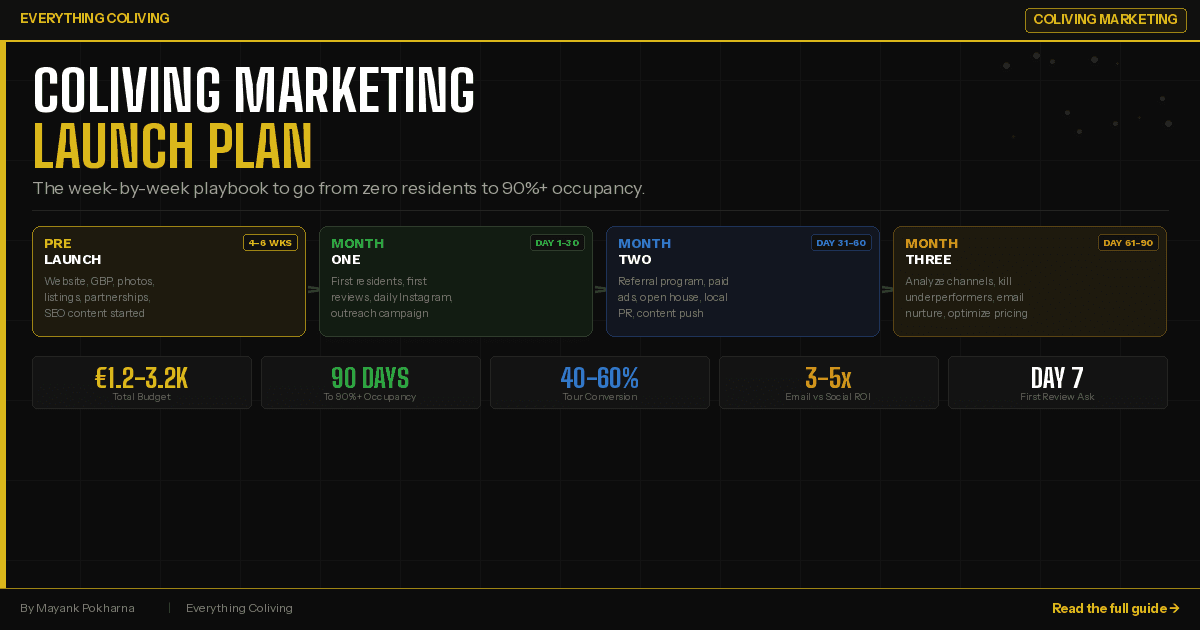
Coliving Marketing Launch Plan: First 90 Days
A week-by-week marketing launch plan for new coliving spaces, covering pre-launch, months 1-3, channel strategy, and a budget of €1,500-€3,000 total.