
Recommended Tools
Free interactive tools related to this article.
On this page
If you want to understand where coliving is heading in 2026, don’t just watch the headlines, watch the rooms where the conversations are happening.
Across Europe and North America, the dialogue around shared living is quietly shifting. We’re moving away from early-stage excitement and abstract debates about whether coliving works, toward something far more meaningful: execution, investment frameworks, policy integration, and operational maturity. The next phase of the industry won’t be shaped only by new projects or funding rounds, but by the ideas, partnerships, and strategies being exchanged at the key gatherings bringing operators, investors, developers, and policymakers into the same room.
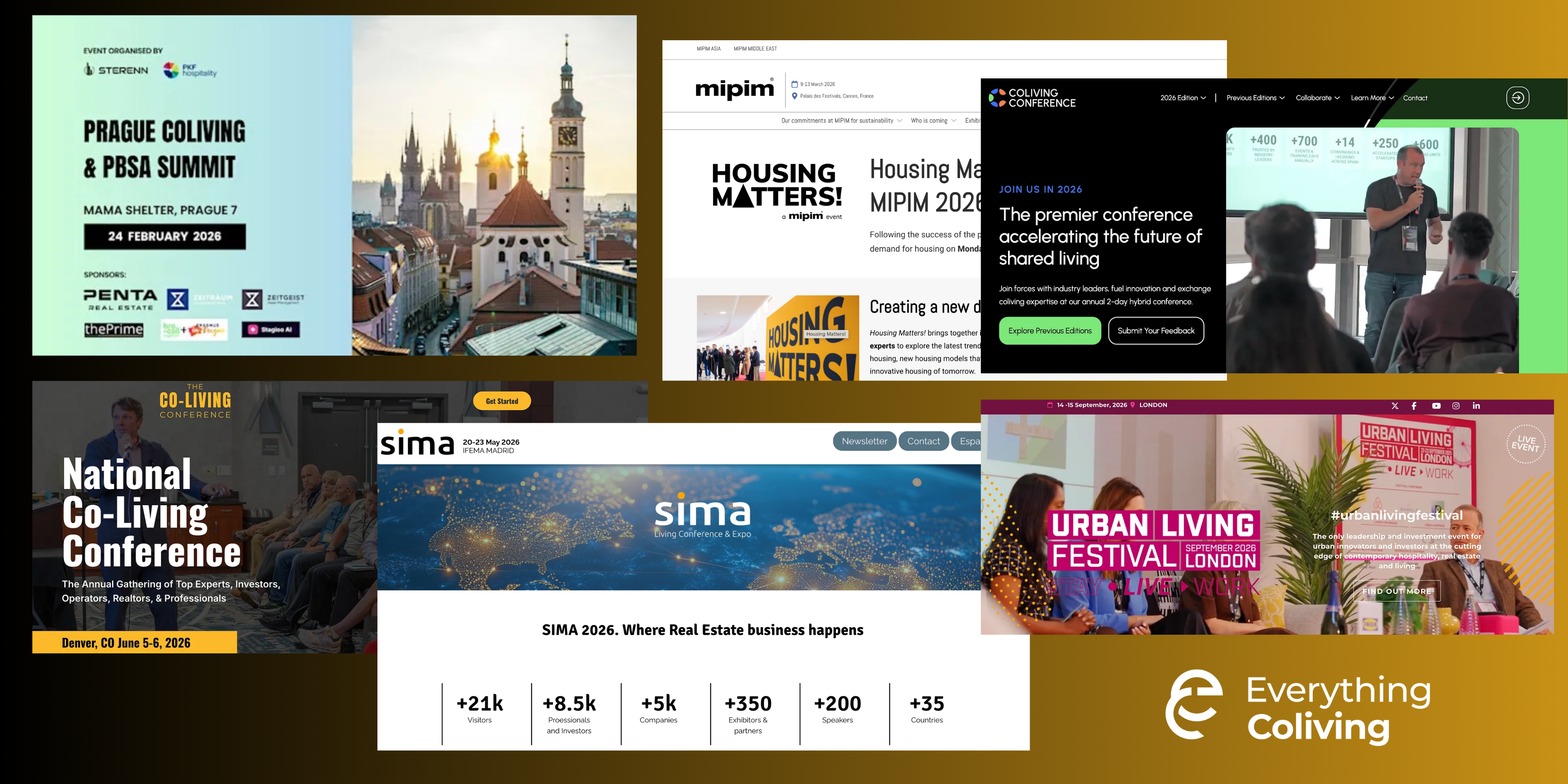
This year’s lineup of events — from Prague and Cannes to Madrid, Denver, London, and the global Coliving Conference — offers a fascinating snapshot of where momentum is building. Each event reflects a different layer of the ecosystem: institutional housing conversations, regional investment signals, operator-driven playbooks, and global alignment around shared living’s future.
[24th Feb, Prague] Prague Coliving & PBSA Summit
Prague Coliving & PBSA Summit brings together decision-maker stakeholders: operators, investors, developers, and proptech. This inaugural event unites investors, developers, operators, advisors, and institutional stakeholders to examine two rapidly expanding and often misunderstood asset classes in European real estate: Coliving and purpose-built student accommodation (PBSA) .
Prague, along with the wider CEE region, is currently at a pivotal juncture. Demand is structural, supply is constrained, and capital is actively searching for scalable, resilient living concepts. Yet the market is still fragmented, short on data, and full of assumptions. This summit aims to sift through the confusion.
Expect practical insights, real market data, and unfiltered discussio n on:
This summit will address where coliving & PBSA are successful & where not.
What investors are underwriting today versus the reality on the ground
How operators, cities, and universities are shaping demand
The regulatory, pricing, and operational challenges ahead
This is a focused, high-level conversation with individuals actively shaping these sectors, without any unnecessary distractions. If you are involved in residential living, hospitality, or alternative real estate and want to understand where these asset classes are heading in Prague and CEE, this is where the conversation starts.
[9th Mar, Cannes] Housing Matters at MIPIM 2026
If you’ve been in housing long enough, you’ll notice a clear shift happening globally: conversations are moving away from whether we need new housing models to how we actually deliver them at scale. That’s why Housing Matters! , returning to MIPIM in Cannes on 9 March 2026, feels particularly relevant right now.
What I find intriguing is that the program isn’t just another real estate conference session talking about affordability in abstract terms. The agenda openly tackles the hard questions, supply shortages, aging populations, student housing pressure, urban migration, and the growing gap between traditional housing products and how people actually live today. And increasingly, models like shared living and coliving sit right in the middle of that discussion.
For operators, investors, and policymakers, this event signals something important: housing innovation is becoming less niche and more institutional. Sessions on collaborative solutions, smart housing strategies, and housing reboot workshops (covering topics like student living, seniors, tech, and climate) suggest that the industry is searching for scalable answers, not just new buzzwords.
Why is this conference worth attending ?
Housing supply and affordability challenges are pushing alternative living models into mainstream policy conversations.
Public-private collaboration is becoming central to how new housing gets built.
Institutional investors are increasingly looking for models that balance impact with stable returns.
Shared living is being discussed alongside broader housing solutions, not as a side conversation anymore.
For me, events like this are less about announcements and more about signals. When global property stakeholders gather to discuss housing in this way, it usually means the market is preparing for its next phase, and shared living operators should be paying attention.
[20-23rd May, Madrid] SIMA 2026: Spain’s Living Sector Comes Into Focus
If MIPIM is where global narratives are shaped, SIMA is increasingly becoming where the living sector conversation gets grounded in real opportunities, especially in Southern Europe. Taking place from 20 to 23 May 2026 at IFEMA Madrid , SIMA continues to position Madrid and Spain as a key gateway for residential investment, affordable housing discussions, and new living models.
What stands out this year is the scale and positioning: more than 21,000 visitors, 5,000 companies, and over 200 speakers focused specifically on housing, investment, and innovation across the living spectrum. For anyone watching coliving, build-to-rent, or residential innovation in Europe, Spain is becoming a market that’s hard to ignore, driven by international capital, changing housing demand, and strong urban migration trends.
SIMA isn’t just a sales expo; it’s increasingly being framed as an ecosystem where developers, investors, operators, and proptech players meet to discuss how housing is evolving. With dedicated areas for professional forums, innovation, and investor opportunities, the event reflects a broader shift: living assets are no longer treated as isolated products but as part of a connected housing ecosystem.
Why does the conference matter for the coliving industry ?
Spain and Madrid are positioning themselves as major hubs for global living-sector investment.
Affordable housing and new residential models are becoming central themes, not side conversations.
Strong international participation signals growing cross-border capital interest in living assets.
The intersection of proptech, operations, and residential investment is moving further into the mainstream.
For me, events like SIMA are useful because they show where momentum is quietly building before it becomes obvious. Whether you're operating, investing, or scaling in coliving or shared living, monitoring Spain's market evolution in 2026 will be crucial.
[5-6th June, Denver, USA] National Co-Living Conference 2026: The US Operator Playbook Goes Mainstream
One of the more intriguing signals this year is how quickly operator-led co-living communities in the U.S. are organizing themselves into structured ecosystems. The National Co-Living Conference , happening in Denver on 5–6 June 2026 , is a strong example of this shift, moving from niche meetups to a large-scale gathering focused heavily on execution, financing, and operational models.
Unlike many global real estate events that discuss co-living at a strategic level, this conference leans deeply into the practical side of the business: operator playbooks, financing structures, investor frameworks, and scaling day-to-day operations. With more than 1,000 expected attendees and multiple specialized tracks, the focus reflects where the U.S. market currently sits: highly entrepreneurial, investor-driven, and increasingly operationally sophisticated.
The conference brings together a diverse range of perspectives, which I find fascinating: passive investors looking for yield, financing specialists navigating DSCR and creative lending, realtors positioning co-living as a cash flow strategy, and hands-on operators solving the realities of occupancy, maintenance, and compliance. It’s less about theory and more about what actually works on the ground.
Why does this matter for the global coliving industry ?
The U.S. model continues to evolve around operator-led, cashflow-focused co-livin g, distinct from institutional European approaches.
Financing and investment education are becoming central, reflecting the maturation of the sector.
Operational excellence, not just design or branding, is increasingly the main discussion point.
Conferences like this show how co-living is moving from “alternative” toward a recognized real estate strategy.
Whether or not you attend, it’s worth watching these regional gatherings closely. They often reveal where the industry is heading 12–18 months before the wider market catches up.
[14-15th Sep, London] Urban Living Festival 2026
The Urban Living Festival 2026 , taking place in London this September, continues to be one of the key leadership and investment gatherings exploring the intersection of hospitality, real estate, and new urban living models, including coliving, serviced living, and flexible accommodation.

What makes this event relevant for the coliving ecosystem is its focus on how cities are rethinking where and how people live, work, and stay. The conversations typically bring together investors, operators, and innovators from across hospitality and living sectors, creating useful cross-industry perspectives around scalability, capital, and evolving consumer expectations.
As coliving increasingly overlaps with broader urban living and hospitality trends, events like this help operators and investors understand where the wider market is heading, especially around institutional interest and hybrid living models.
Why does it matter ?
Strong focus on investment and leadership trend s across urban living sectors
Brings hospitality and real estate perspectives into the shared-living conversation
Useful lens on how coliving fits into the wider evolution of contemporary housing
If you’re tracking the convergence of hospitality and housing, this is one of the London events worth watching in 2026.
[September] Coliving Conference 2026: Where the Global Industry Aligns
While many events are now discussing shared living from the sidelines, the Coliving Conference 2026 continues to position itself as one of the few gatherings built specifically by and for the global coliving ecosystem. Entering its fourth edition, the conference brings together operators, developers, investors, suppliers, and thought leaders to discuss where shared living is actually heading, beyond the hype cycle.
What stands out here is the international lens. With participants from across Europe, North America, Asia, and beyond, the conversations tend to go deeper into real operational challenges, emerging business models, and evolving living typologies rather than just high-level trends. The format blends panels, interactive sessions, and product showcases, making it as much about peer learning as it is about networking.

The event also reflects a broader shift in the industry: coliving is moving from experimentation toward consolidation and professionalization. Topics like scalability, affordability, investment structures, and resident experience are increasingly central to the dialogue, signalling a maturing sector trying to define its long-term identity.
Why does it matter for the industry ?
One of the few global-only platform s dedicated entirely to coliving and shared living.
The platform brings together a diverse group of operators, investors, and ecosystem players who are actively shaping future standards.
This platform signals the evolution of the industry from “concept-driven” to execution-focused conversation s.
This platform showcases emerging living models and cross-market insights that are often overlooked in regional events.
If you want to see how coliving is changing worldwide, this is a key 2026 event to watch.
Updates on Coliving Conference 2026
If there’s one clear takeaway from looking at this year’s event landscape, it’s this: coliving is no longer operating at the edges of the housing conversation.
Whether it’s investors discussing scalable living models in Cannes, operators sharing practical playbooks in Denver, or global stakeholders aligning perspectives at the Coliving Conference, the industry is moving from experimentation toward structure. The questions being asked are changing, from “Does coliving work?” to “How do we make it work sustainably at scale?”
For operators, developers, and investors, these gatherings are less about announcements and more about signals. They reveal where capital is leaning, how regulation is evolving, which operational models are surviving real-world pressures, and where collaboration between sectors is beginning to take shape.
And perhaps most importantly, they remind us that coliving doesn’t evolve in isolation. It sits at the intersection of housing affordability, urban planning, hospitality, and changing lifestyles — meaning the future will be shaped by those willing to engage across industries and geographies, not just within their own local bubble.
2026 will likely be remembered as another transition year for shared living. The hype cycle is settling, execution is becoming the real differentiator, and the conversations happening at these events will quietly influence what the next decade of housing looks like. If you’re building, operating, investing, or simply curious about where shared living is headed, these are conversations worth paying attention to.
Written by
Admin
Admin is a contributor at Everything Coliving, the leading growth platform for coliving operators worldwide. Everything Coliving has been featured in 50+ publications including Forbes, BBC, and Financial Express.
You Might Also Like

What Is Coliving? The Definitive Guide for 2026
Everything you need to know about coliving in 2026. What it is, how it works, who it's for, what it costs, and why it's becoming the housing model of the future.
January 7, 2026

Coliving vs Cohousing: Key Differences Explained
Coliving and cohousing are two of the most prominent alternatives to traditional housing, and they are frequently confused with each other. Both reject the...
February 25, 2026

What Is Coliving? The Complete Guide to Co-Living in 2026
Picture this: you move to a new city for work. Instead of spending weeks hunting for an apartment, negotiating with landlords, buying furniture, and setting...
February 20, 2026